Mary Musgrove and the Founding of Savannah
The Muscogee Trader, Diplomat and Interpreter Who Helped Make Savannah Possible
Before Savannah had its celebrated squares, church steeples and elegant streets, three people stood at the center of an uncertain encounter on the bank of the Savannah River.
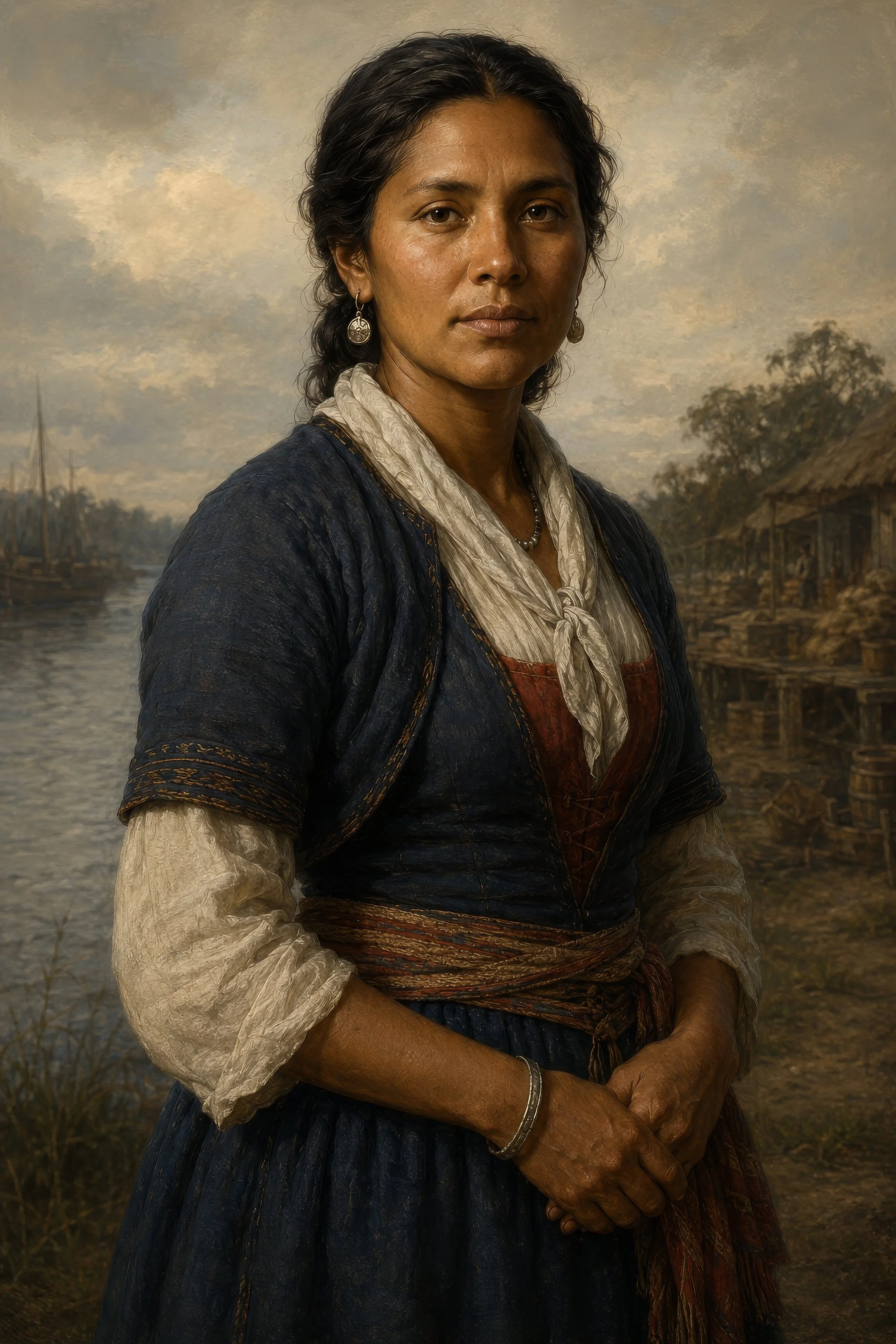
Mary Musgrove, also known as Coosaponakeesa, served as a trader, diplomat and principal interpreter between James Oglethorpe and the Muscogee. No authenticated portrait from her lifetime is known to survive. This artistic reconstruction was created by Charles Maring for Savannah Proper using historical and period references.
James Oglethorpe had arrived with British colonists and a charter to establish Georgia. Tomochichi, mico of the Yamacraw, led the people living on the land Oglethorpe hoped to settle. Between them stood Mary Musgrove, also known by her Muscogee name, Coosaponakeesa.
Mary listened to both men. She understood their words, but her importance went far beyond language. She understood the customs, expectations and political relationships surrounding them. Oglethorpe and Tomochichi could speak through her, but they also depended upon her ability to recognize what each man meant and what each side needed from the other.
No surviving account gives us every word exchanged during Savannah’s founding. We should not imagine that the city emerged from one simple conversation. The agreement developed through meetings, negotiation and the independent decisions of Yamacraw and British leaders. What the historical record makes clear is that Mary Musgrove helped make meaningful communication possible.
Her role in Savannah’s founding was essential, but it was only one chapter in the life of a remarkable Muscogee woman who became a trader, diplomat, interpreter, landowner and formidable political presence in colonial Georgia.
Coosaponakeesa Between Two Worlds
Mary Musgrove was born around 1700 in Coweta, a Lower Muscogee town. Her father was an English trader generally identified as Edward Griffin. Her mother was a Muscogee woman whose name has not been securely established in the historical record.
Muscogee society was matrilineal. Children received their clan identities through their mothers, which made Mary a member of the Wind Clan and a full participant in Muscogee society. Describing her simply as half English and half Creek does not adequately explain who she was. That description reflects European ideas about ancestry more than the social world into which Mary was born.
She was known among the Muscogee as Coosaponakeesa. She spent portions of her childhood in both Muscogee country and colonial South Carolina, learning to speak Muscogee and English. She became literate and acquired an intimate understanding of the customs, relationships and commercial practices of both societies.
These abilities would eventually make her indispensable. They also allowed her to build a life that did not fit neatly within the boundaries either society attempted to impose upon her.
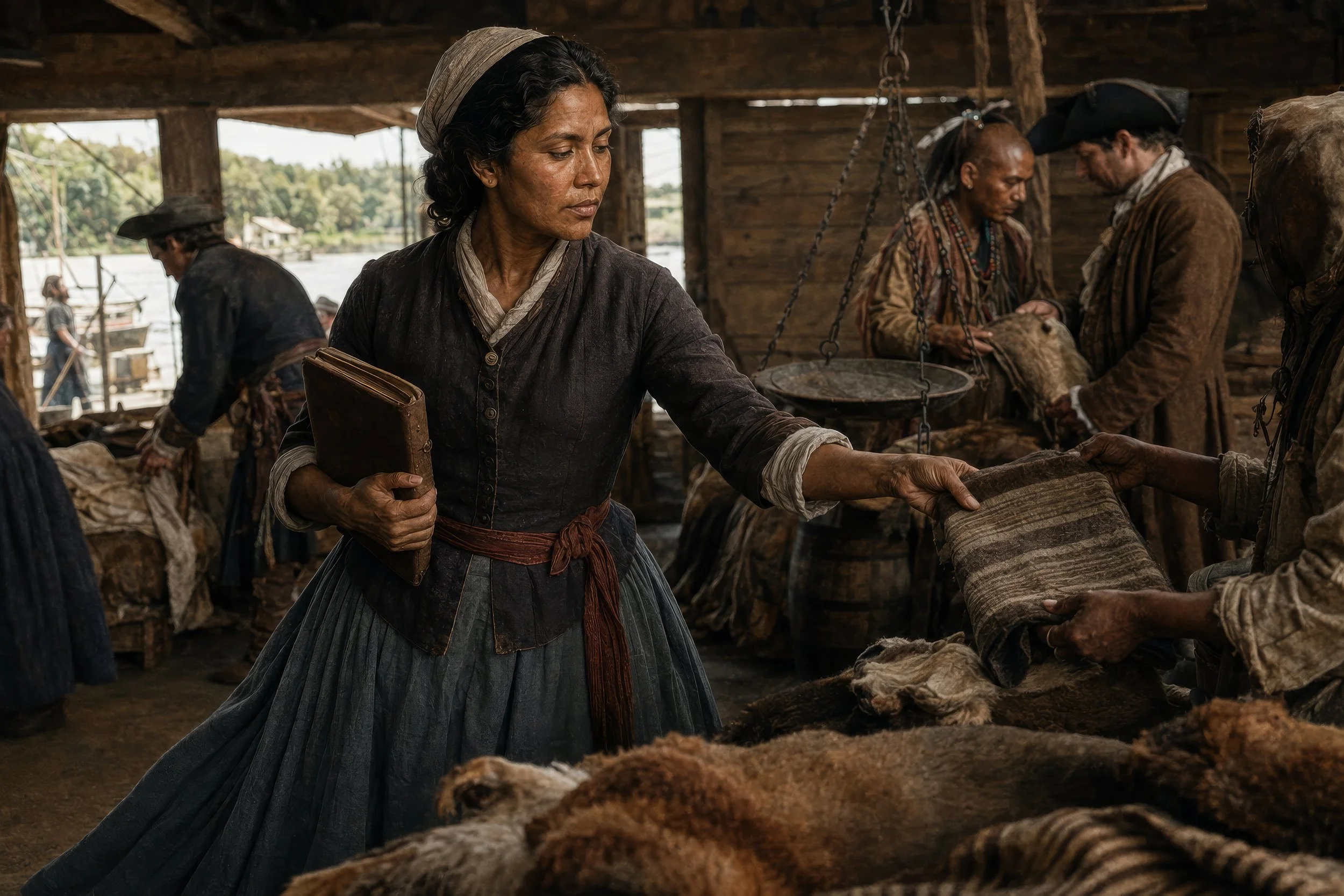
Mary Musgrove imagined managing activity at the Cowpens trading post, an important center of commerce between British colonists and the Muscogee. This artistic reconstruction is based on historical accounts of her work as a trader and entrepreneur. Created by Charles Maring for Savannah Proper.
A Businesswoman on the Savannah River
In 1717, Mary married English trader John Musgrove. Together they became involved in the trade connecting Muscogee communities with British merchants in South Carolina and, eventually, Georgia.
Deerskins were among the most valuable commodities moving through this commercial network. Muscogee hunters supplied hides that British merchants exported for use in clothing, bookbinding and other manufactured goods. In return, British traders supplied textiles, metal tools, kettles and other imported products.
The Musgroves operated a trading post near the Savannah River. Historical sources differ about the chronology and location of their earliest operations, but their business was established before or during the earliest years of Georgia’s settlement. After John’s death, Mary moved the operation to Yamacraw Bluff. Known as the Cowpens, it became an important center of trade between the British and the Muscogee.
This was not a quaint store on the edge of the wilderness. It was a place of commerce, hospitality, diplomacy and information. People arrived to exchange goods, deliver messages, discuss alliances and learn what was happening throughout the region.
Mary’s command of both languages made the business possible, but so did her Muscogee family relationships. Her knowledge and connections attracted customers and placed her at the center of an extensive cultural and political network.
Her historical significance did not begin when Oglethorpe needed an interpreter. Mary was already a businesswoman with valuable knowledge, commercial experience and influence.
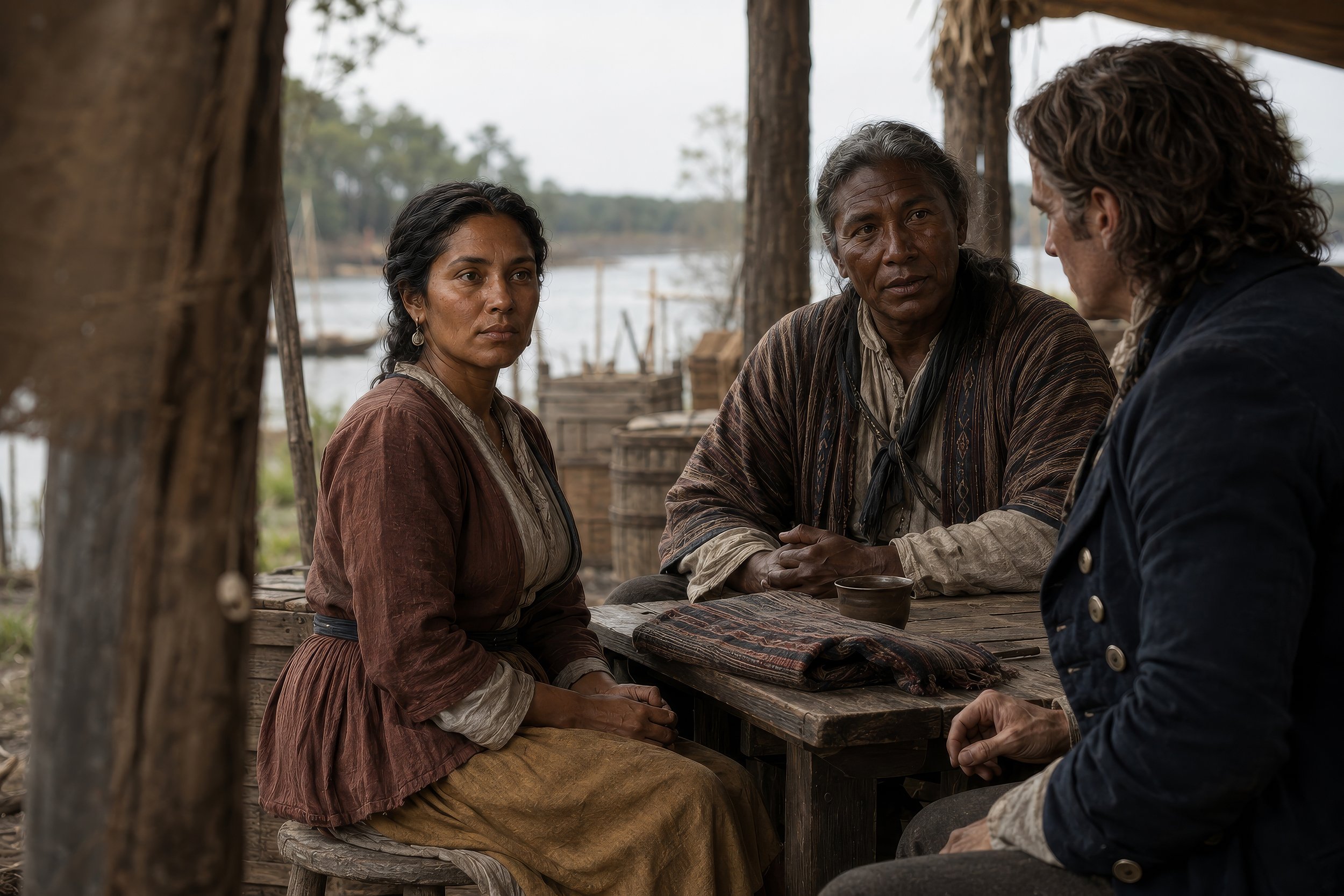
An artistic reconstruction of Mary Musgrove facilitating communication between Yamacraw mico Tomochichi and James Oglethorpe near Yamacraw Bluff in 1733. Mary’s knowledge of both languages and cultures helped make meaningful negotiation possible. Created by Charles Maring for Savannah Proper.
The Negotiations That Helped Establish Savannah
When Oglethorpe and the first Georgia colonists arrived in 1733, they entered a region where Native and European people had been trading, negotiating and competing for generations.
Tomochichi had established the Yamacraw community near the Savannah River. He recognized potential advantages in a relationship with the newcomers, including expanded trade and a stronger political connection with the British. Oglethorpe needed a place to settle, access to regional knowledge and peaceful relations with the people already occupying the land.
Mary became the principal interpreter between them.
Tomochichi possessed his own authority as the Yamacraw mico. Oglethorpe represented the Georgia Trustees and the ambitions of the British Empire. Mary did not grant the land to Oglethorpe, nor did she make decisions on Tomochichi’s behalf. Her role was to allow two leaders with different languages and political traditions to understand one another well enough to negotiate.
The relationship that developed among Tomochichi, Oglethorpe and Mary helped make the peaceful establishment of Savannah possible. It was a partnership shaped by cooperation, but also by distinct interests. Each person had something to gain, something to protect and reasons to remain cautious.
Readers can explore Tomochichi’s role more deeply in Tomochichi and the Founding of Savannah and Oglethorpe’s life in James Oglethorpe: The Founder of Savannah.
More Than an Interpreter
From 1733 until 1743, Mary served as Oglethorpe’s principal interpreter in his dealings with the Muscogee. She received financial compensation and considerable prestige, although later disputes reveal that she did not believe the colony had fully compensated her for her services and losses.
Oglethorpe relied upon Mary for information about Muscogee customs, leadership and political relationships. She helped communicate speeches, treaty proposals and diplomatic messages. She traveled, hosted visitors and contributed to efforts to maintain peaceful relations between British colonists and Muscogee communities.
Interpretation in the eighteenth century was not a mechanical act. Many English ideas had no precise Muscogee equivalent, just as Muscogee concepts of family, authority, diplomacy and land could not always be expressed adequately through English legal language.
Mary had to decide how to communicate meaning across that divide. She translated not only words but the political intentions behind them.
That gave her influence, but it also placed her in a precarious position. Each side could benefit from her knowledge while questioning whether her loyalties belonged elsewhere. Her ability to operate between societies created opportunity, but it also exposed her to suspicion from both.
Mary’s household became known for hospitality. John Wesley was among the visitors received at the Musgrove home, and he recognized her ability to speak, read and write across cultures. His own difficult experience in the young colony is explored in John Wesley and Savannah.
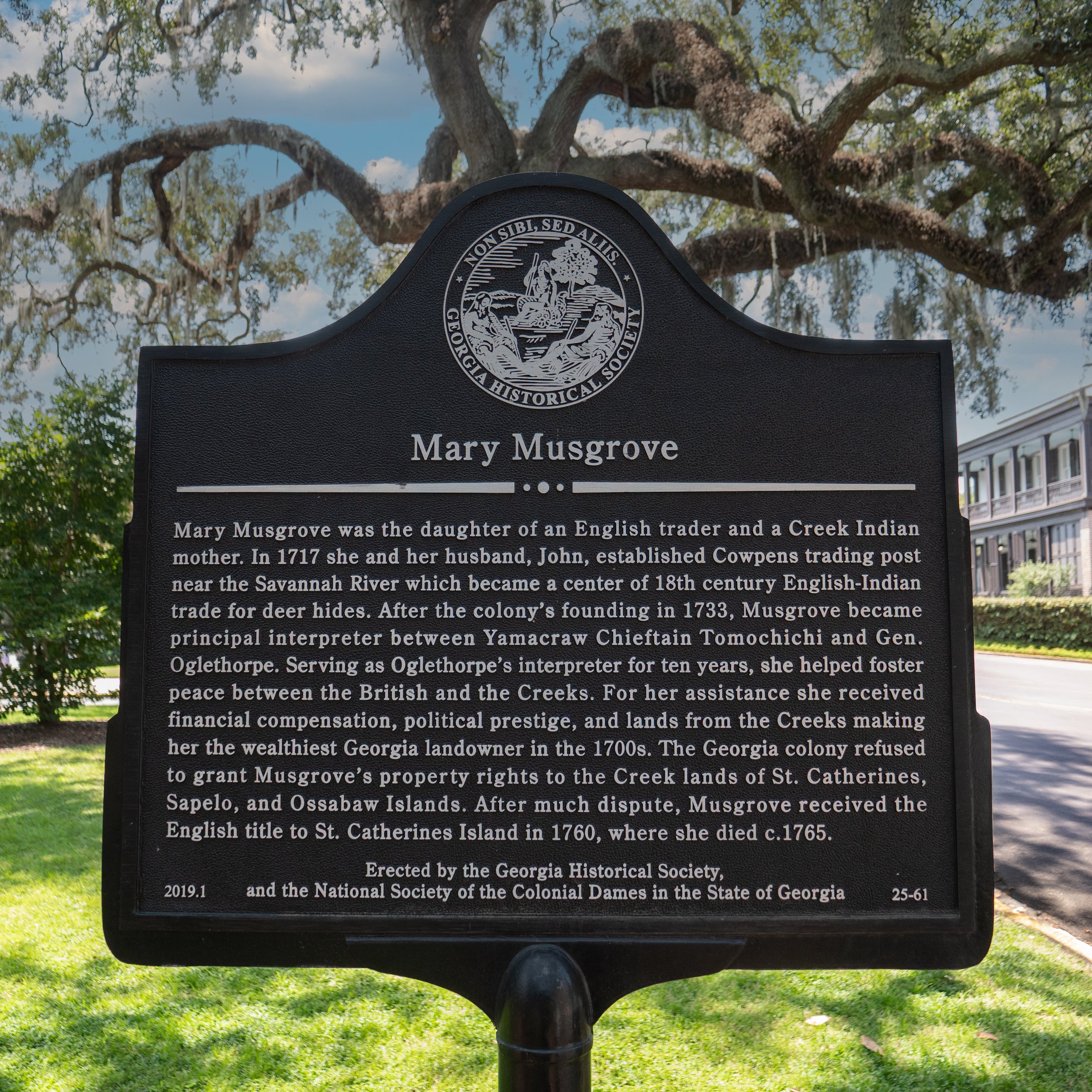
This historical marker recognizes Mary Musgrove’s essential role in communication and diplomacy between English colonists and the Muscogee people during Georgia’s earliest years. Photograph by Artist Charles Maring.
Widowhood, Enterprise and Reinvention
John Musgrove died in 1735. Mary did not retreat from public life. She continued operating the Cowpens trading post and remained involved in Oglethorpe’s diplomacy.
She married Jacob Matthews in 1737. With his assistance, she established another trading operation at Mount Venture on the Altamaha River. Its location placed Mary closer to the contested southern frontier, where British and Spanish ambitions threatened to erupt into open conflict.
Jacob Matthews died in 1742, leaving Mary widowed for a second time. Oglethorpe departed Georgia the following year and never returned. His departure removed the colonial official who had depended most directly upon Mary and understood the value of her work.
In 1744, Mary married the Reverend Thomas Bosomworth. Their marriage elevated her position within colonial society, but it also marked the beginning of the most controversial chapter of her life.
Together, Mary and Bosomworth traveled into Muscogee communities, carried messages and hosted Native and colonial visitors. They also began pressing claims to land that Mary believed had been granted to her legitimately.
The Colony Turns Against Its Indispensable Partner
Mary’s land claims had roots in grants made by Muscogee leaders. Tomochichi granted her land near Savannah in 1737. Later, the Lower Muscogee leader Malatchi granted Mary and Thomas Bosomworth claims to St. Catherines, Sapelo and Ossabaw Islands.
To Mary and her supporters, these grants represented legitimate transfers made through Muscogee authority. British colonial officials saw the matter differently. They maintained that Indigenous land could be ceded to the British Crown but could not be conveyed directly to private individuals.
The dispute was therefore larger than one woman’s desire to own several islands. It exposed incompatible understandings of land and sovereignty.
Could Muscogee leaders grant land according to their own political traditions, or did the British Crown possess the exclusive power to recognize ownership? Could the colony accept Mary’s diplomatic work while rejecting the authority through which she claimed property? Did the compensation she received reflect the true value of her services and commercial losses?
Mary refused to allow colonial officials to answer those questions without opposition.
She submitted claims, sought compensation and used her political relationships to build support. The same skills that had once made her invaluable to Georgia now made her difficult for its government to ignore.
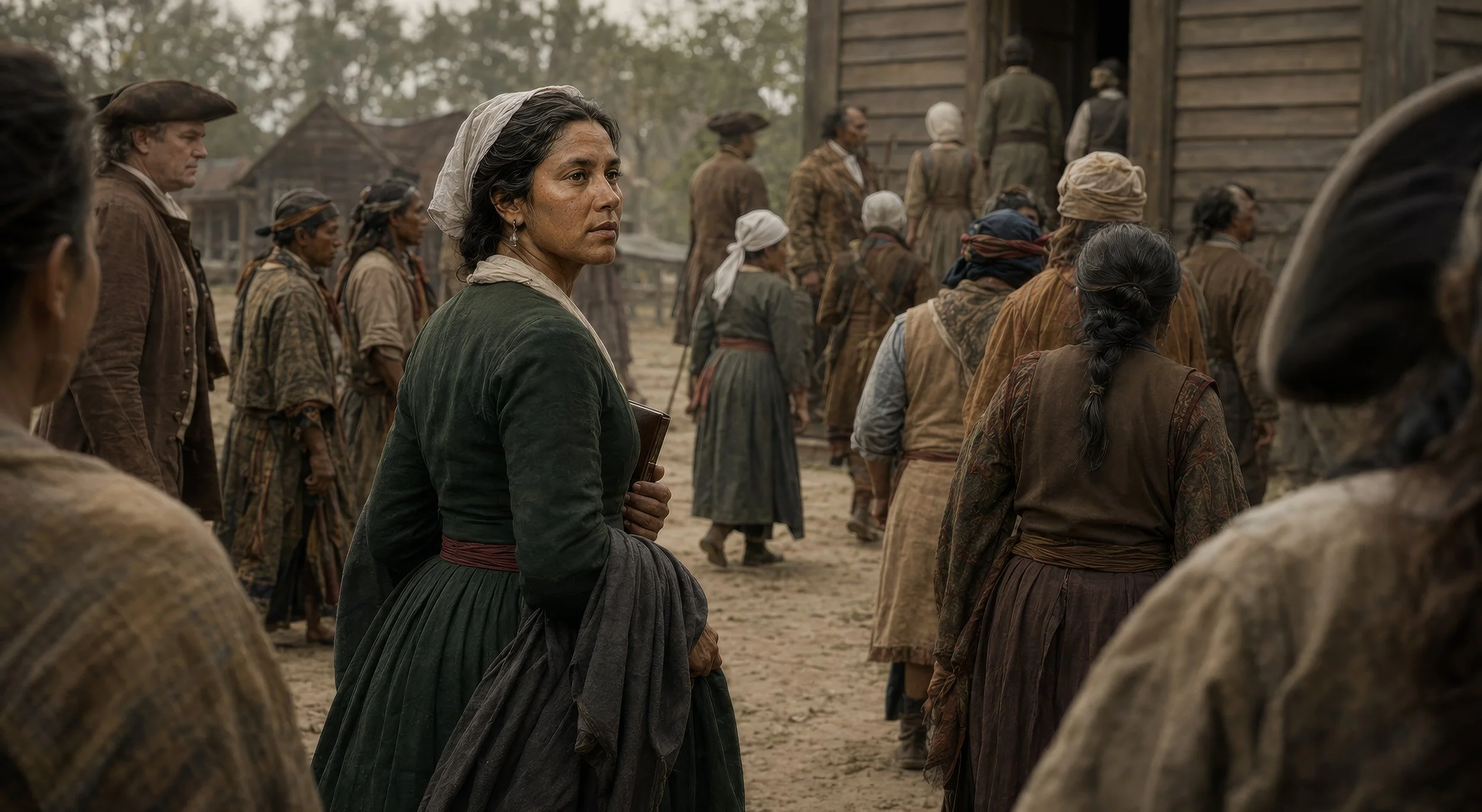
In 1749, more than 200 Muscogee people accompanied Mary Musgrove to Savannah in support of her land and compensation claims. This artistic reconstruction depicts her approaching colonial officials during the tense political dispute. Created by Charles Maring for Savannah Proper.
Mary Musgrove Confronts Savannah
In 1749, more than 200 Muscogee people accompanied Mary to Savannah in support of her claims.
It must have been a startling sight. The woman who had helped Oglethorpe communicate with Tomochichi now approached the colonial government as a claimant demanding recognition. She was no longer being asked to translate someone else’s position. She was advancing her own.
Older accounts often portrayed this episode through the fears and prejudices of colonial observers. Mary was depicted as an unruly woman, a supposed Indian queen or the instigator of a threatening uprising. Such descriptions served the interests of officials who wanted to dismiss her claims and undermine her authority.
The documented confrontation was certainly tense. It strained Mary’s relationship with colonial leaders and complicated her standing within Muscogee politics. But reducing the episode to an angry outburst removes the years of service, financial loss, rejected petitions and conflicting legal traditions that brought her to Savannah.
Mary understood that the colony had benefited from her knowledge. She also understood that British officials were becoming less willing to recognize her political influence when it challenged their control over land.
The interpreter had become an adversary.
A Fight That Crossed the Atlantic
Mary continued pursuing her claims for years. She and Bosomworth traveled to England to present their case, but returned to Georgia without an immediate resolution.
The dispute survived changes in Georgia’s government and the end of the Trustee period. Mary’s persistence forced officials to continue confronting a matter they might otherwise have ignored.
In 1760, a settlement was finally reached. Mary received title to St. Catherines Island and £2,100 while relinquishing her claims to the other disputed lands.
The agreement did not give her everything she had sought, but it represented a remarkable conclusion. A Muscogee woman born around 1700 had challenged colonial authorities, crossed the Atlantic to pursue her case and ultimately secured ownership of one of Georgia’s barrier islands along with substantial compensation.
Mary spent her final years on St. Catherines Island. Sources differ about the precise year of her death, placing it sometime during the mid 1760s.
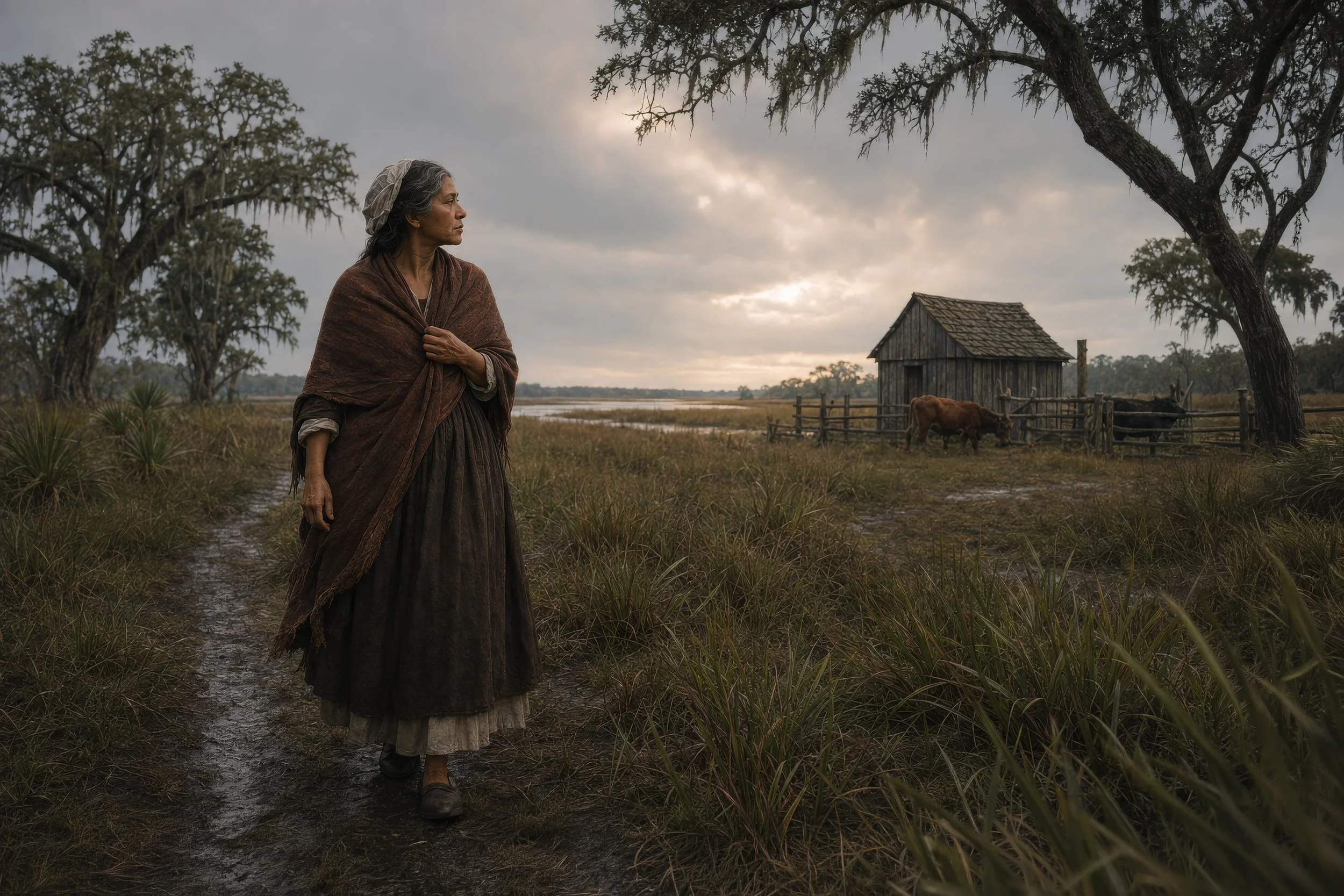
Mary Musgrove spent her final years on St. Catherines Island after securing English title to the island through a settlement reached in 1760. This contemplative scene is an artistic reconstruction created by Charles Maring for Savannah Proper.
Remembering Mary Musgrove in Savannah
Today, a historical marker in Lafayette Square commemorates Mary’s life. Erected in 2019 by the Georgia Historical Society and the National Society of the Colonial Dames in the State of Georgia, it recognizes her work as a trader and as the principal interpreter between Tomochichi and Oglethorpe.
Lafayette Square was not the site of Mary’s trading post or the negotiations that helped establish Savannah. The marker is a place of remembrance rather than the location where the central events of her life occurred.
To understand Mary’s Savannah, we must look toward Yamacraw Bluff, the river and the commercial world that connected the coast to Muscogee country. Her story also stretches southward along the Altamaha and across the water to St. Catherines Island.
Mary Musgrove’s life resists the simple categories history once assigned to her. She was neither merely Oglethorpe’s interpreter nor the romanticized “Creek princess” found in some older accounts. She was a Muscogee woman, a Christian, an entrepreneur, a diplomat, a wife, a widow, a landowner and a political actor.
She used her understanding of two societies to create an extraordinary position within colonial Georgia. Yet her life also revealed the limits of that position. Savannah needed Mary Musgrove before its government was prepared to recognize her as an equal political and economic force.
The city remembers Oglethorpe as its founder and Tomochichi as the Native leader who welcomed the colonists. Mary belongs beside them.
Savannah was not created through the vision of one man. It emerged through negotiation among people who arrived at Yamacraw Bluff with different histories, languages and hopes for the future.
Mary Musgrove made it possible for them to understand one another.
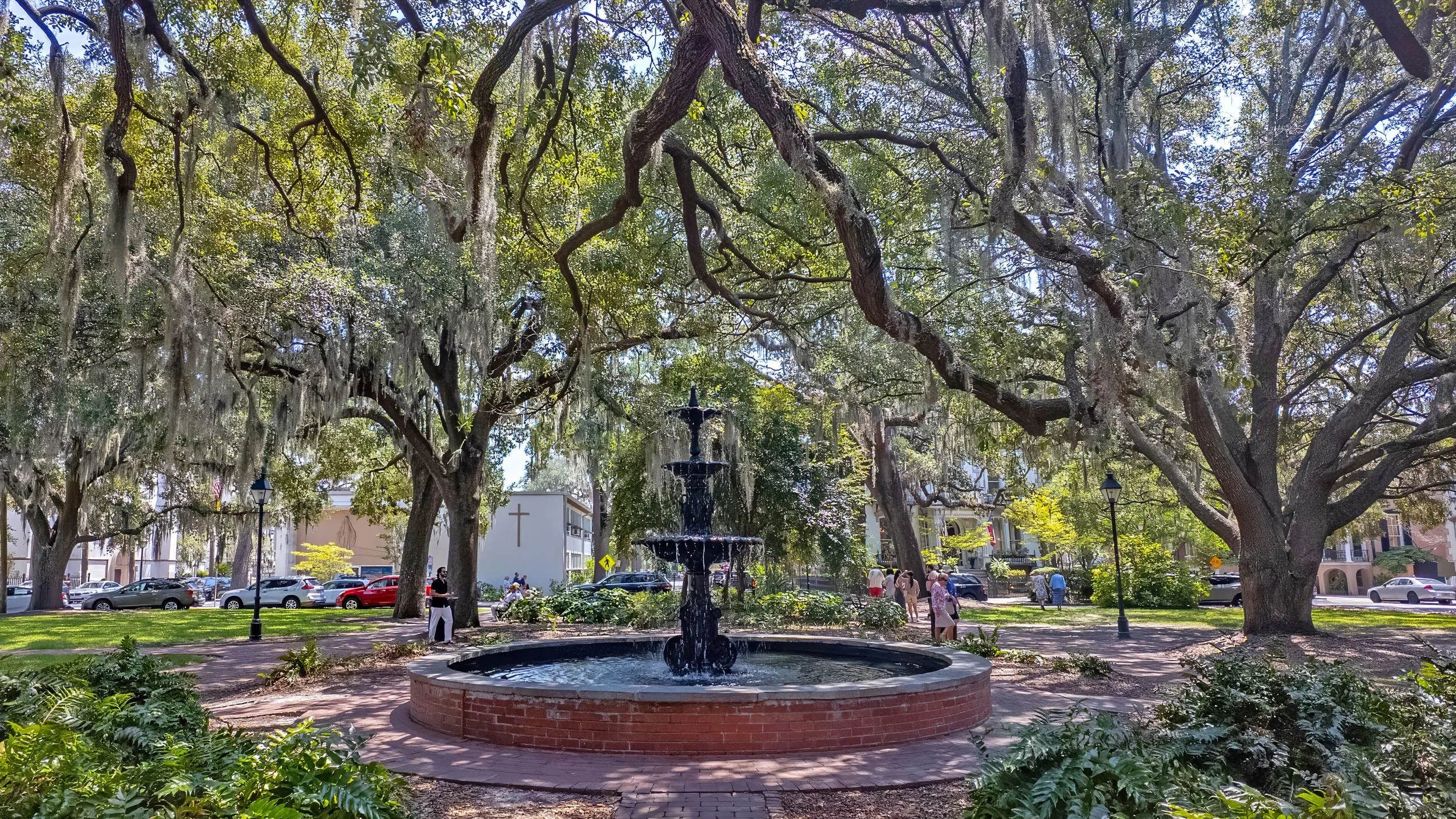
The fountain in Lafayette Square commemorates the 250th anniversary of Georgia’s founding. Although installed centuries later, it recalls the colonial beginning in which Mary Musgrove served as an indispensable interpreter, diplomat and cultural intermediary. Photo by Maring Visuals for Savannah Proper.
Sources and Further Reading
This story was researched using material from the Georgia Historical Society, the New Georgia Encyclopedia, the Digital Library of Georgia, the Georgia Archives, the National Park Service and Steven C. Hahn’s scholarly biography, The Life and Times of Mary Musgrove.
Mary Musgrove, New Georgia Encyclopedia
Mary Musgrove Historical Marker, Georgia Historical Society
Oglethorpe and Tomochichi, Georgia Historical Society
Proceedings Related to Mary Musgrove, Georgia Archives
The Life and Times of Mary Musgrove, University Press of Florida