Johnson Square: Where Savannah’s Story Began
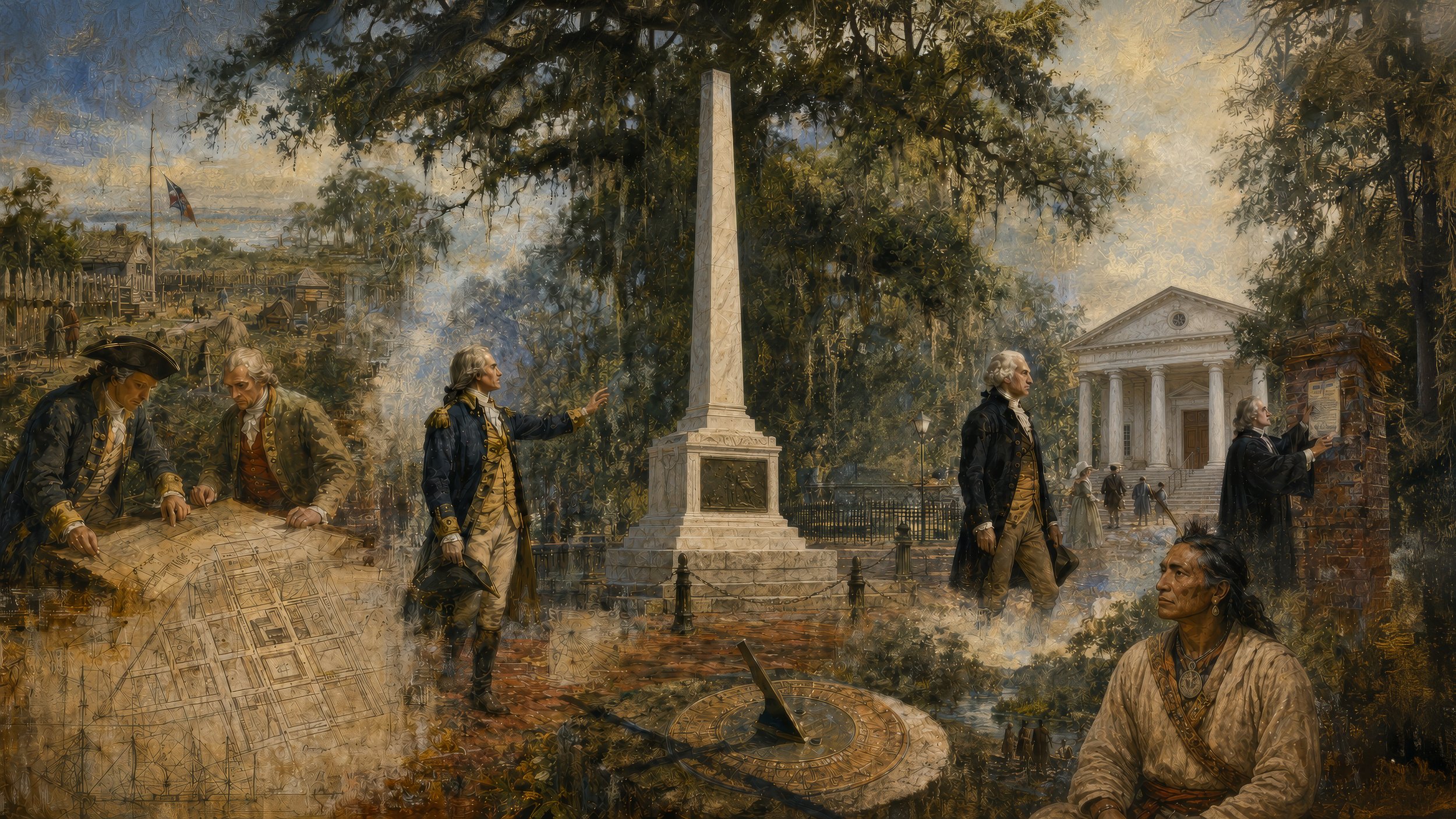
Where Savannah Gathered, a contemporary artistic interpretation of the people, places and pivotal moments woven into Johnson Square’s layered history. Imagined by Charles Maring for Savannah Proper.
Johnson Square is more than a shaded place to rest beneath Savannah’s live oaks. Established in 1733, it was the first of the city’s squares and became an early center of civic life, worship, commerce, public ceremony, and political expression. Nearly three centuries later, it remains one of the most historically layered places in Savannah.
At its center stands the monument to Revolutionary War general Nathanael Greene. Around it are reminders of James Oglethorpe’s city plan, the colonial beginnings of Christ Church, visits by George Washington and the Marquis de Lafayette, and the generations of residents and travelers who have continued to gather here.
To understand Johnson Square is to begin at the beginning of Savannah itself.
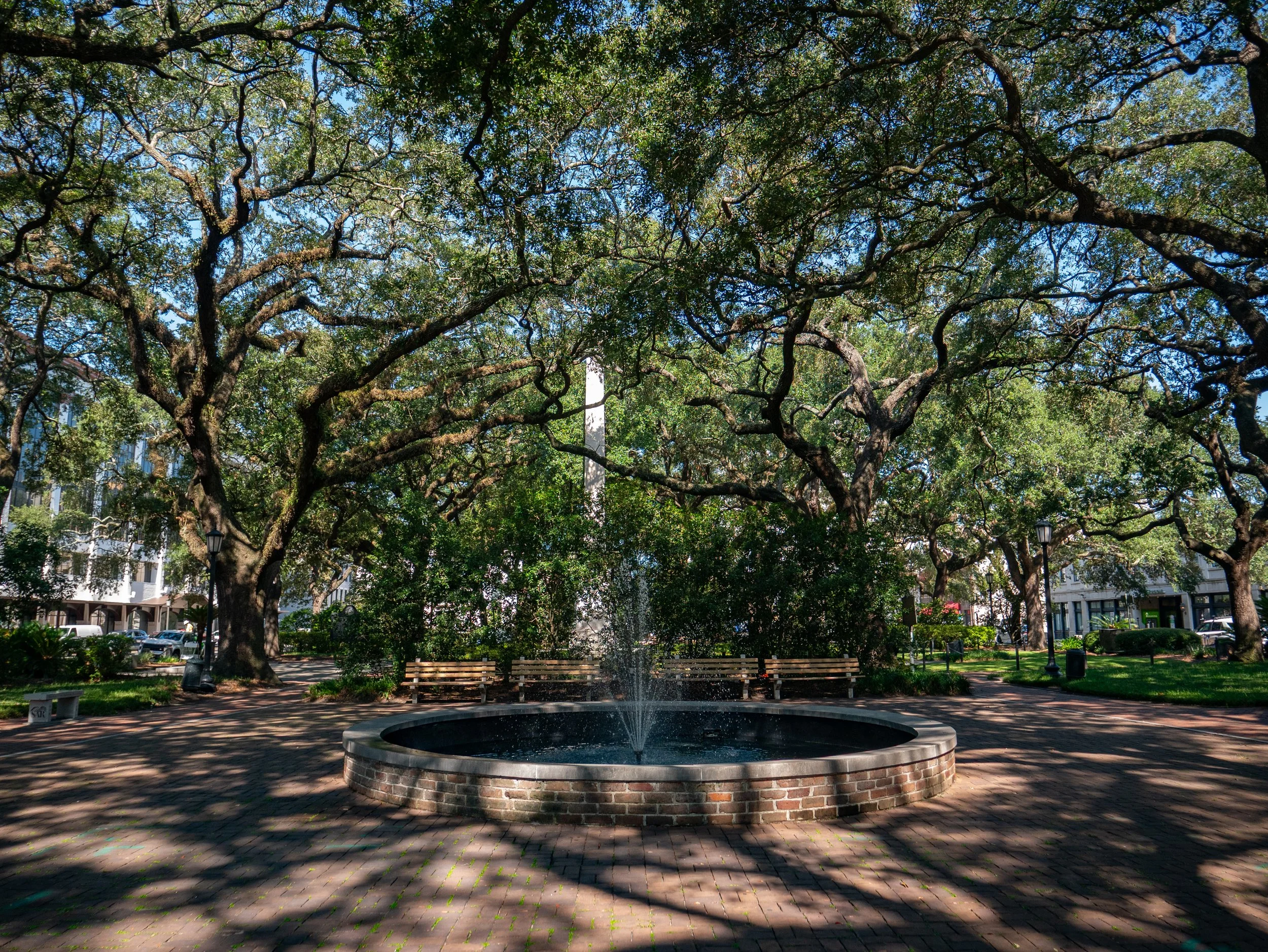
Brick paths and an expansive live oak canopy give Johnson Square its distinctive sense of place. Photography by Charles Maring for Savannah Proper.
Savannah’s First Square
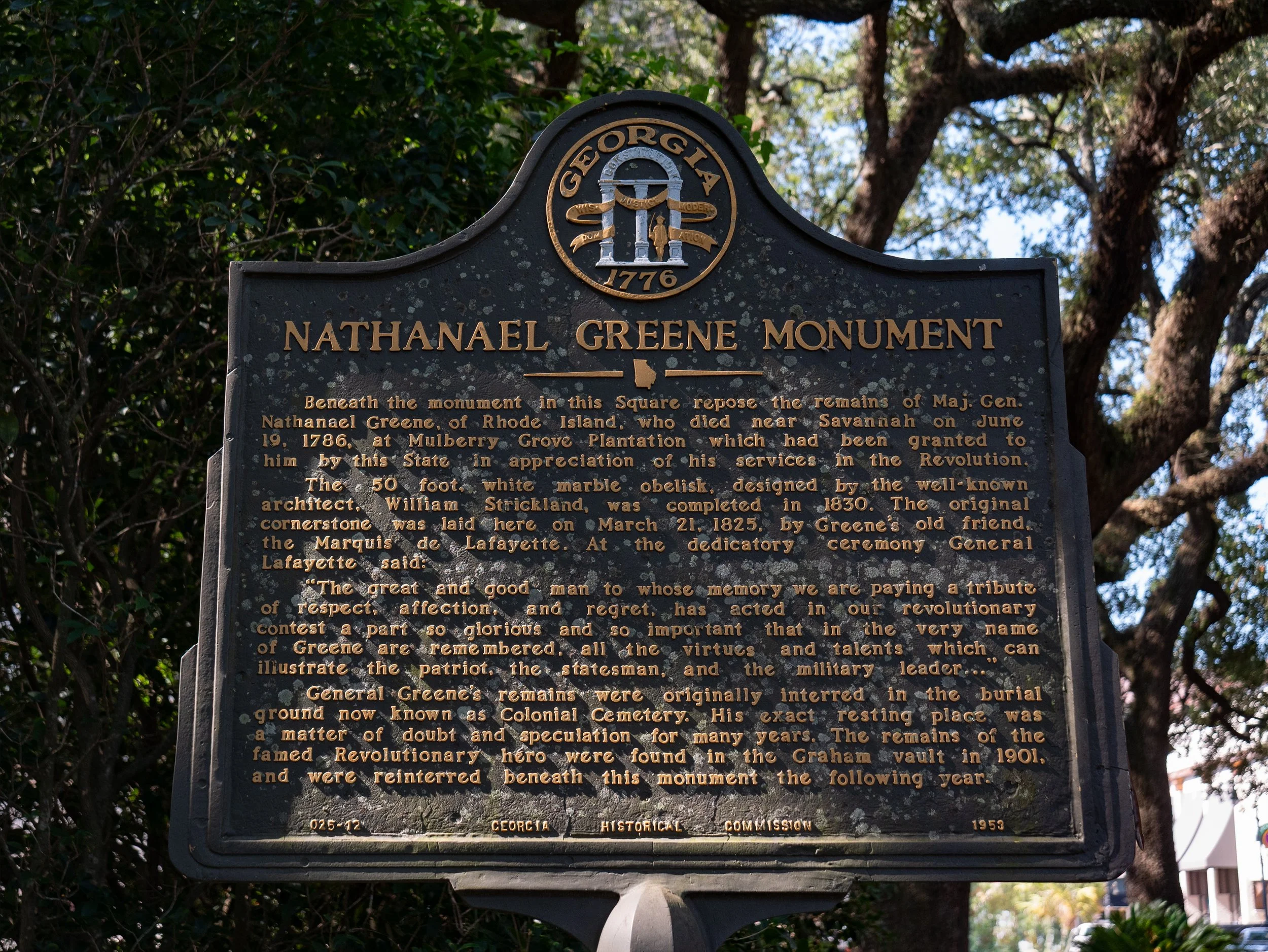
The Nathanael Greene Monument marker recounts the obelisk’s construction and the 1902 reinterment of Greene and his son beneath it.
Johnson Square was laid out in 1733 by James Oglethorpe and Colonel William Bull as the new Georgia settlement took shape along the Savannah River. It was named for Robert Johnson, the governor of South Carolina who assisted and befriended the colonists during Georgia’s earliest days.
The square was not conceived simply as a decorative park. It was part of a larger civic plan in which public spaces, trust lots, homes, and working areas were arranged to create an organized community.
In early colonial Savannah, the public stores, a house for newly arrived strangers, a church, and a public bake oven stood around Johnson Square. These were essential parts of daily life in a settlement still establishing itself on the edge of the British Atlantic world.
The arrangement established a pattern that would come to define Savannah. Public squares gave the city breathing room, but they also created places where residents could meet, worship, exchange news, conduct business, and participate in civic life.
A Place Where Savannah Gathered
Many of Johnson Square’s most significant moments left no surviving building or monument. They endure through written records and historical markers.
According to the Georgia Historical Society’s Johnson Square marker, Chekilli, a leader of the Creek Nation, recited the origin story of the Creeks here in 1735. That moment reminds us that Savannah’s colonial history developed within a much older Indigenous world and through relationships with Native leaders and communities.
In 1737, John Wesley posted a public notice in Johnson Square announcing his intention to return to England. His troubled experience in Savannah lasted less than two years, but the religious movement he later helped lead would have an international influence.
The Declaration of Independence was publicly read in Johnson Square on August 10, 1776, bringing the revolutionary cause directly into Savannah’s civic center. The city would later be occupied by British forces during the American Revolution and become the site of the unsuccessful Siege of Savannah in 1779.
Johnson Square continued to host important public events after the Revolution. A temporary pavilion was constructed here for a ball honoring President James Monroe in 1819. Lafayette spoke here during his celebrated return to America in 1825. Henry Clay and Daniel Webster were among the nationally prominent figures who addressed audiences in the square during the nineteenth century.
These moments reveal the square’s original purpose. It was not merely scenery surrounding Savannah’s history. It was one of the places where that history happened.
The Nathanael Greene Monument
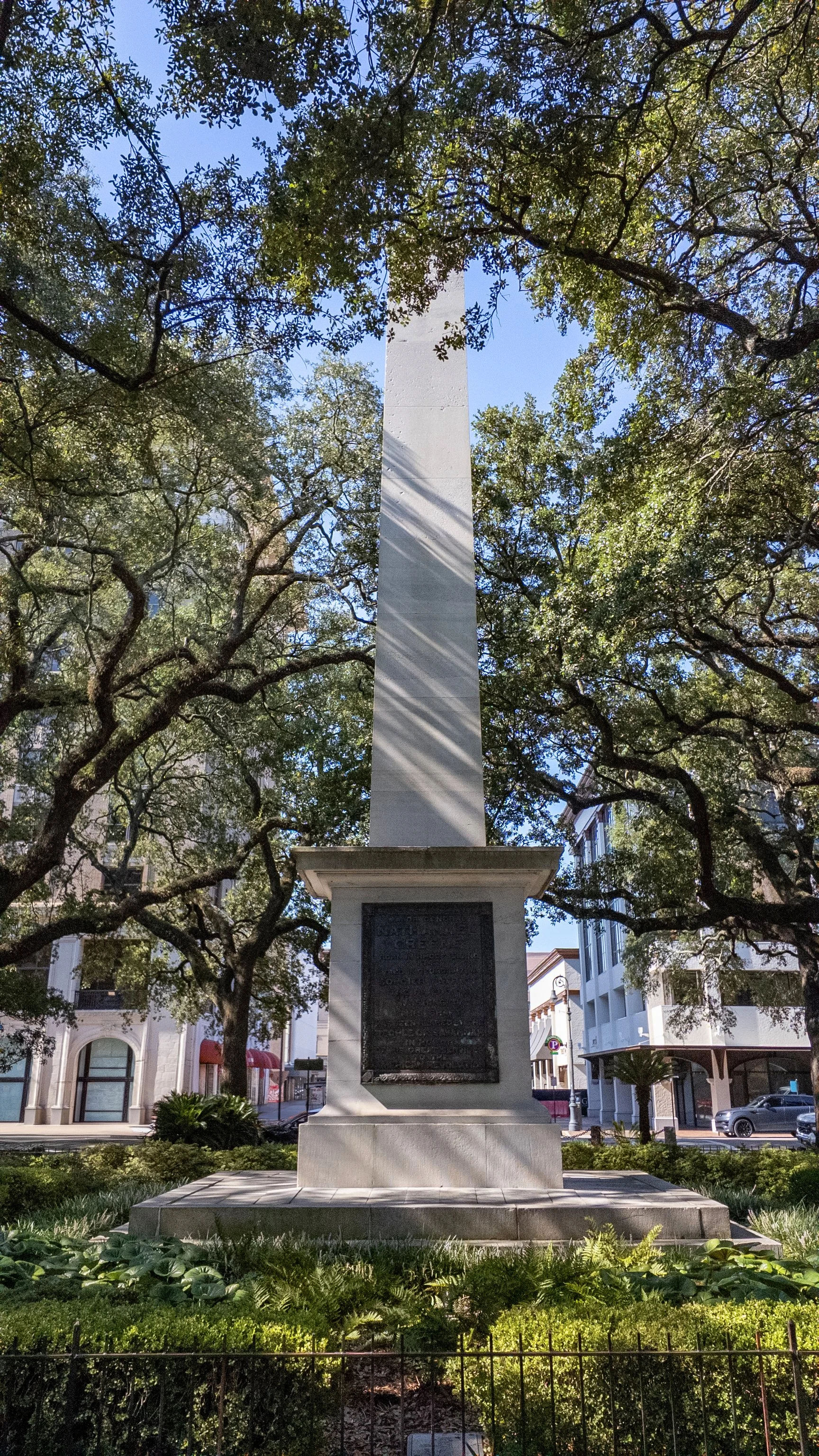
The approximately 50-foot marble monument to Revolutionary War general Nathanael Greene was completed in 1830.
The dominant landmark in Johnson Square is the white marble obelisk honoring Major General Nathanael Greene.
Greene was born in Rhode Island in 1742 and became one of George Washington’s most trusted commanders during the American Revolution. As commander of the Southern Department, he led a strategic campaign that weakened British control across the Carolinas and helped change the direction of the war.
Georgia granted Greene Mulberry Grove Plantation near Savannah in recognition of his service. He lived there for less than a year before his death on June 19, 1786, at the age of 44.
The monument in Johnson Square was designed by architect William Strickland. Its cornerstone was laid on March 21, 1825, by the Marquis de Lafayette, Greene’s friend and fellow veteran of the Revolution. The approximately 50-foot marble obelisk was completed in 1830.
The monument originally commemorated Greene without containing his remains. He had been buried in the cemetery now known as Colonial Park Cemetery, but the precise location of his burial was eventually lost.
In 1901, remains believed to be those of Greene were identified in the Graham family vault with the help of a coffin plate bearing his name. On November 14, 1902, Greene and his son, George Washington Greene, were reinterred beneath the Johnson Square monument.
The obelisk therefore serves as both a public memorial and a tomb.
A bronze relief on its base gives Greene a human presence beneath the towering stone. Seen up close, he appears not as an abstract name from the Revolution but as a military leader standing amid the people and events of his time.
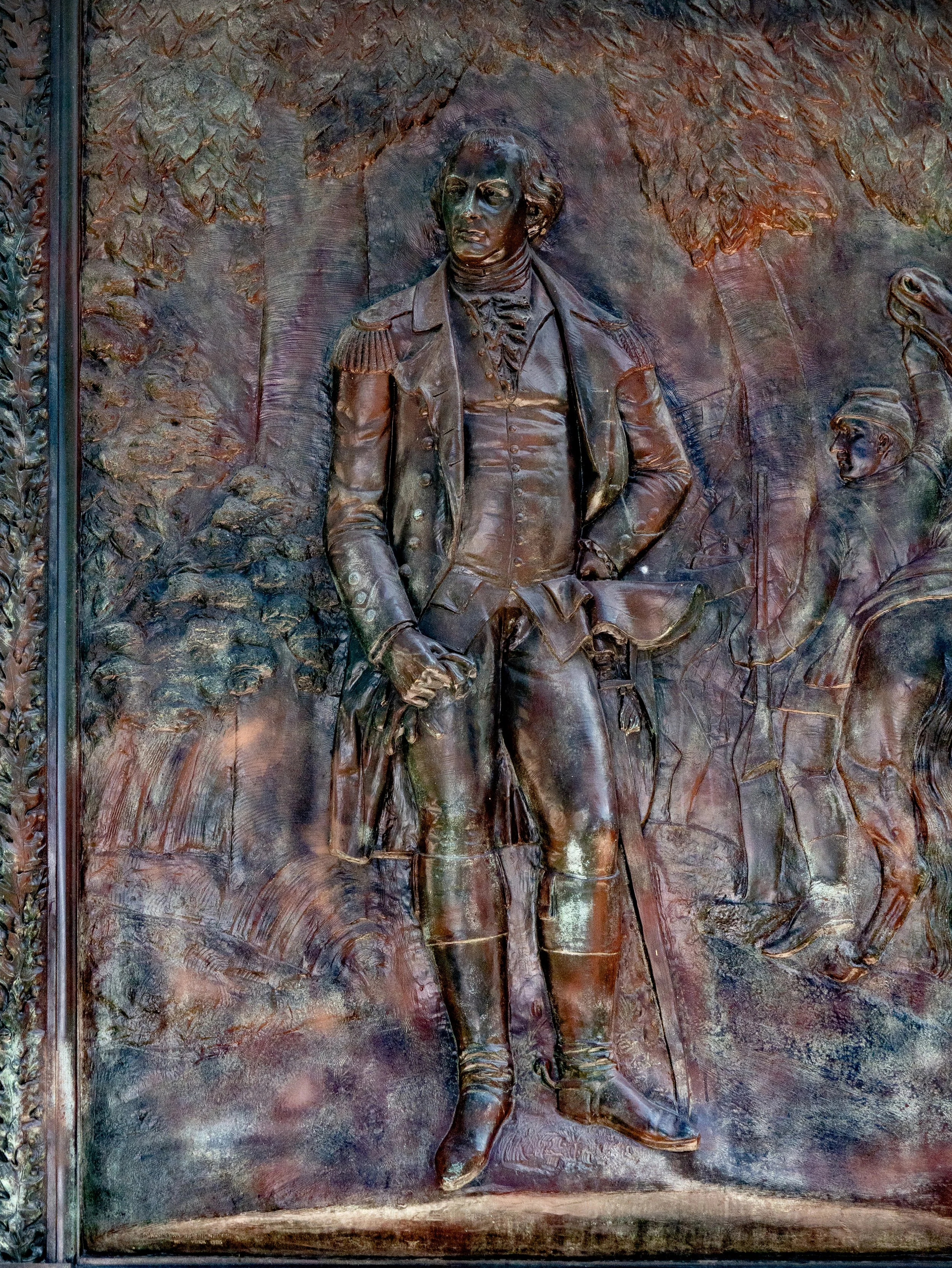
A bronze relief on the monument depicts Nathanael Greene, one of George Washington’s most trusted commanders.
Lafayette Returns to Honor an Old Friend
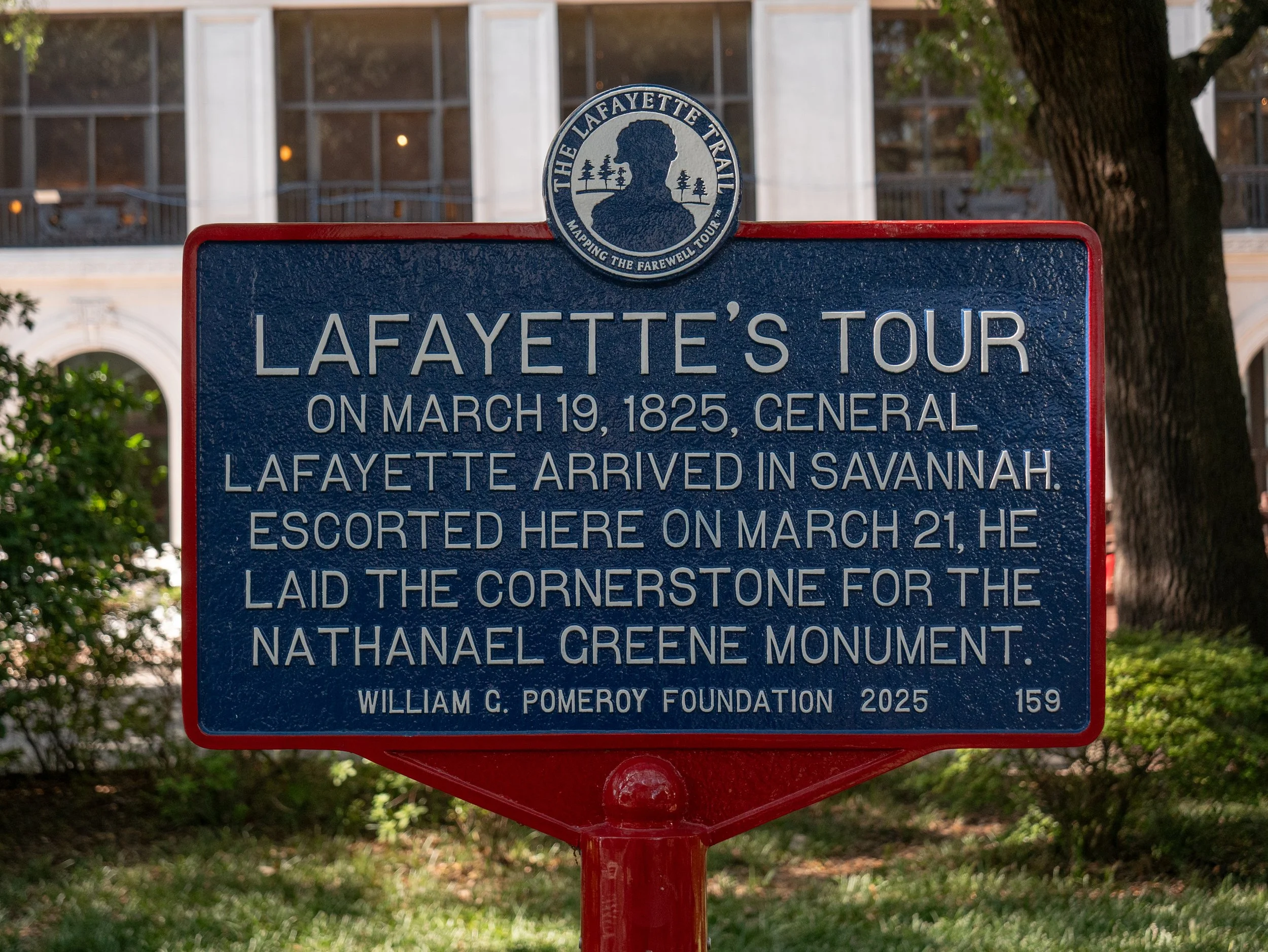
The Marquis de Lafayette laid the cornerstone of the Nathanael Greene Monument on March 21, 1825.
Lafayette’s role in the monument connects Johnson Square to one of the most celebrated American tours of the nineteenth century.
The French general arrived in Savannah on March 19, 1825, during his farewell tour of the United States. Two days later, he laid the cornerstone for the Nathanael Greene Monument before a public gathering in Johnson Square.
Lafayette and Greene had shared the experience of the Revolution. The ceremony was therefore more than an official appearance by a famous visitor. It was a tribute from one veteran of the founding generation to another.
A marker in the square now identifies the location as part of the Lafayette Trail, a national effort tracing the general’s journey through the United States. It allows visitors to stand where Savannah gathered to welcome one of the last surviving major figures of the Revolution.
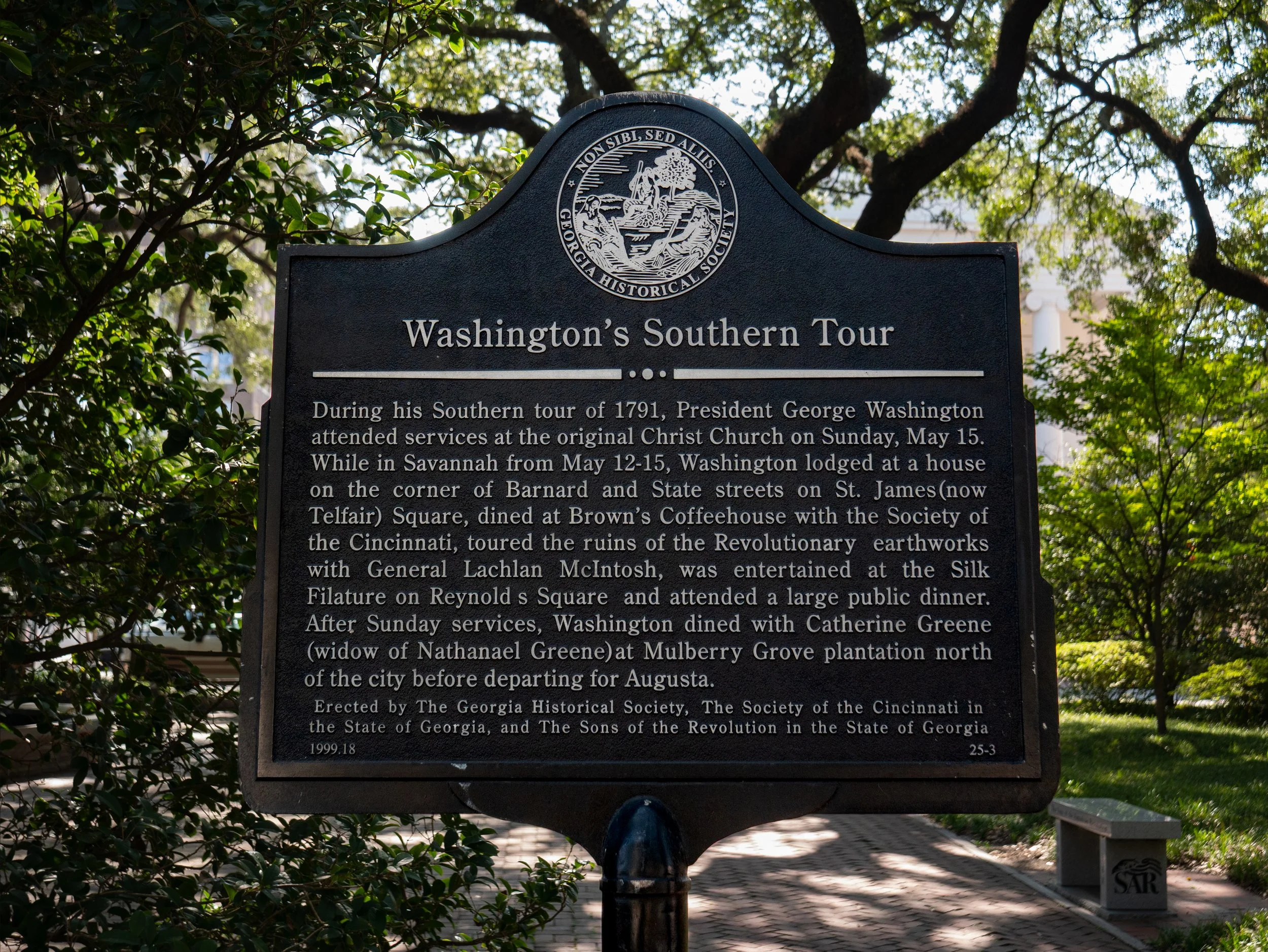
George Washington attended services at the original Christ Church on May 15, 1791, during his Southern Tour.
George Washington Comes to Savannah
Johnson Square also preserves a connection to George Washington’s 1791 Southern Tour.
Washington visited Savannah from May 12 through May 15 while traveling through the southern states as the nation’s first president. On Sunday, May 15, he attended services at the original Christ Church beside Johnson Square.
His Savannah itinerary extended throughout the historic district. He lodged near what is now Telfair Square, dined at Brown’s Coffeehouse, toured Revolutionary War earthworks with General Lachlan McIntosh, and was entertained at the Silk Filature on Reynolds Square.
After attending church, Washington dined with Catherine Greene, Nathanael Greene’s widow, at Mulberry Grove before departing for Augusta.
The Washington’s Southern Tour marker in Johnson Square connects several people and places that might otherwise appear to be separate stories. Washington, the Greene family, Christ Church, Reynolds Square, Telfair Square, and the legacy of the Revolution all intersect through one presidential visit.
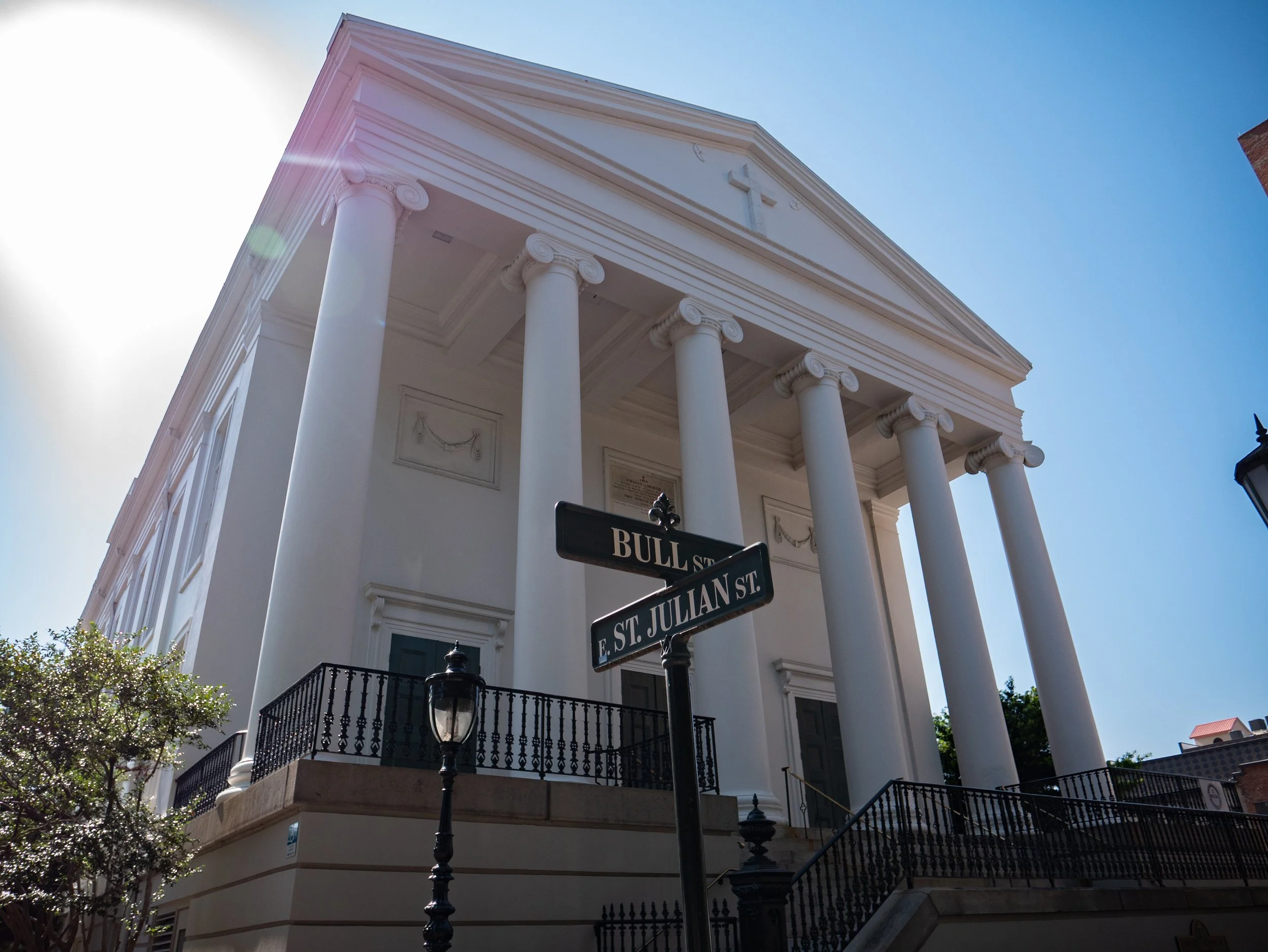
Christ Church Episcopal stands beside Johnson Square, where the congregation’s history reaches back to Georgia’s founding.
Christ Church and the Beginnings of Worship in Georgia
Facing Johnson Square is Christ Church Episcopal, often called the Mother Church of Georgia.
The Christ Church marker traces the congregation’s history from 1733 and identifies early rectors John Wesley and George Whitefield.
The congregation traces its origins to the founding of the colony in 1733. Early rectors included John Wesley, who served in Savannah from 1736 to 1737, and George Whitefield, who later established Bethesda Orphanage.
The cornerstone of the first church building on the present site was laid in 1744. The current building is the third structure associated with the site and was designed by James Hamilton Couper in 1838. Its classical façade and tall columns now form one of the square’s defining architectural views.
An 1819 bell made by Revere & Son remains in use. Juliette Gordon Low, the Savannah native who founded the Girl Scouts of the USA, was among the congregation’s prominent members.
Christ Church makes it possible to read the history of Johnson Square across multiple centuries. The congregation began during Savannah’s colonial formation, welcomed President Washington in 1791, and remains active beside the square today.
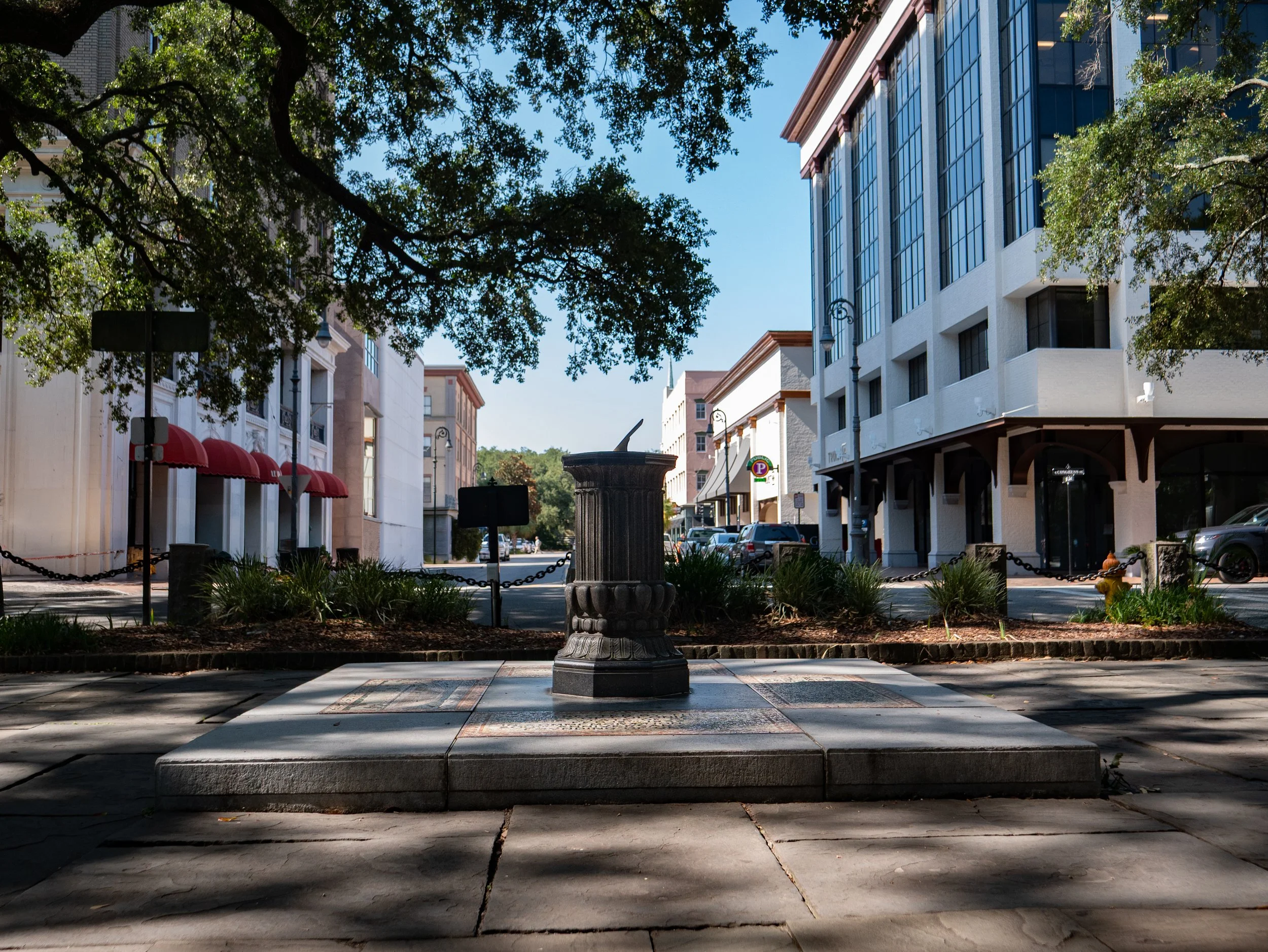
The Johnson Square sundial honors Colonel William Bull, who assisted James Oglethorpe in laying out early Savannah.
The Colonel William Bull Sundial
Near the square’s pathways is another monument to Savannah’s beginnings: the Colonel William Bull Sundial.
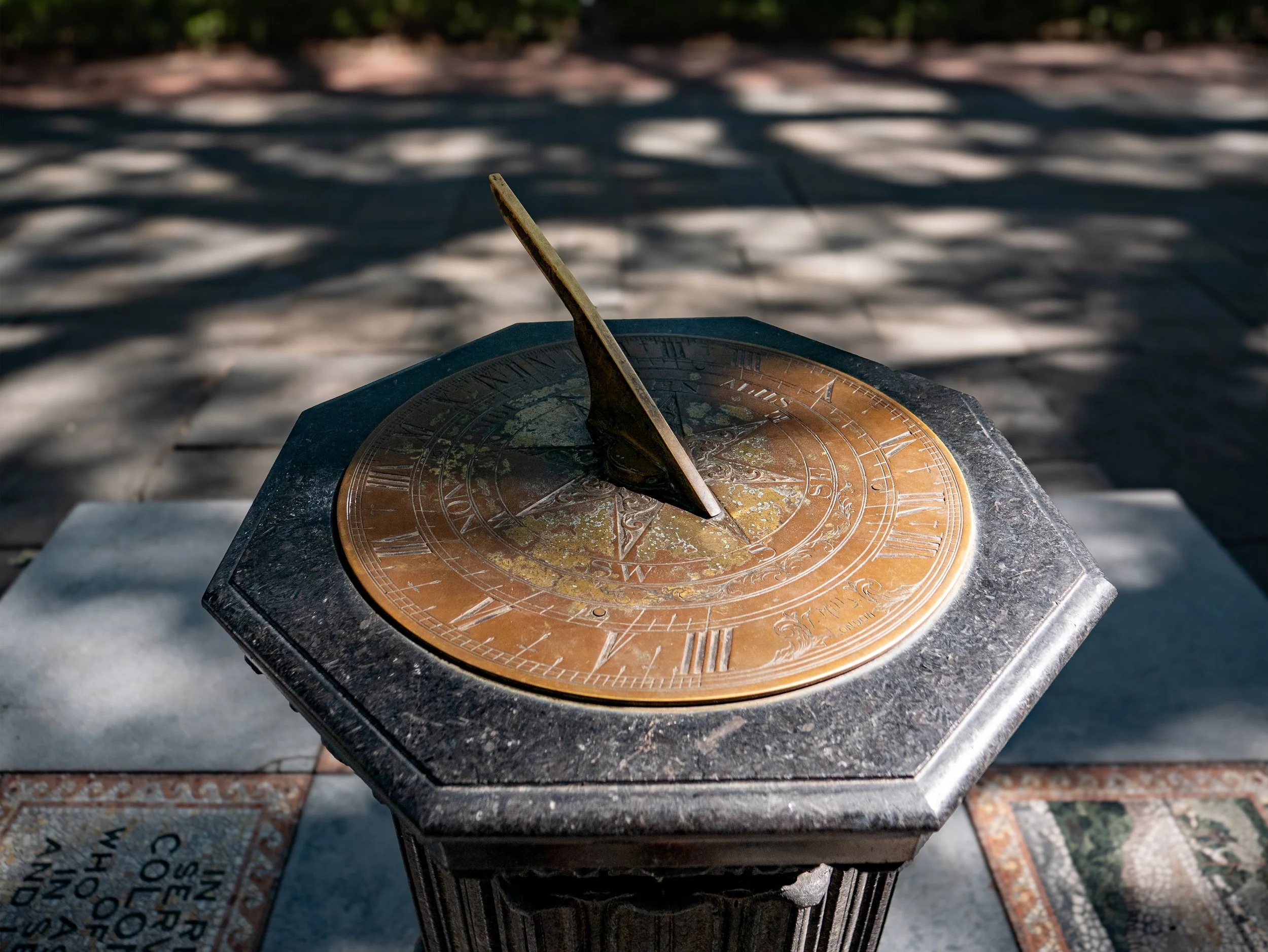
Sunlight crosses the weathered bronze face of the Colonel William Bull Sundial.
The sundial was erected in connection with the 200th anniversary of Georgia’s founding. It honors the South Carolina surveyor who assisted Oglethorpe in selecting Savannah’s site and laying out the early settlement.
A bronze sundial sits atop an ornate pedestal surrounded by mosaic panels. One recognizes Colonel Bull’s role in selecting the site and establishing Savannah’s plan. Another depicts a view of Savannah in 1734. Together, the mosaics turn a functional instrument for measuring time into a reflection on the city’s beginnings.
The placement feels particularly appropriate. In a square that has witnessed nearly three centuries of change, the sundial makes the passage of time part of the experience.
Today, visitors gather around it, study its mosaics, and try to interpret the shadow cast across its bronze face. It has become both a historical object and an interactive feature of the square.
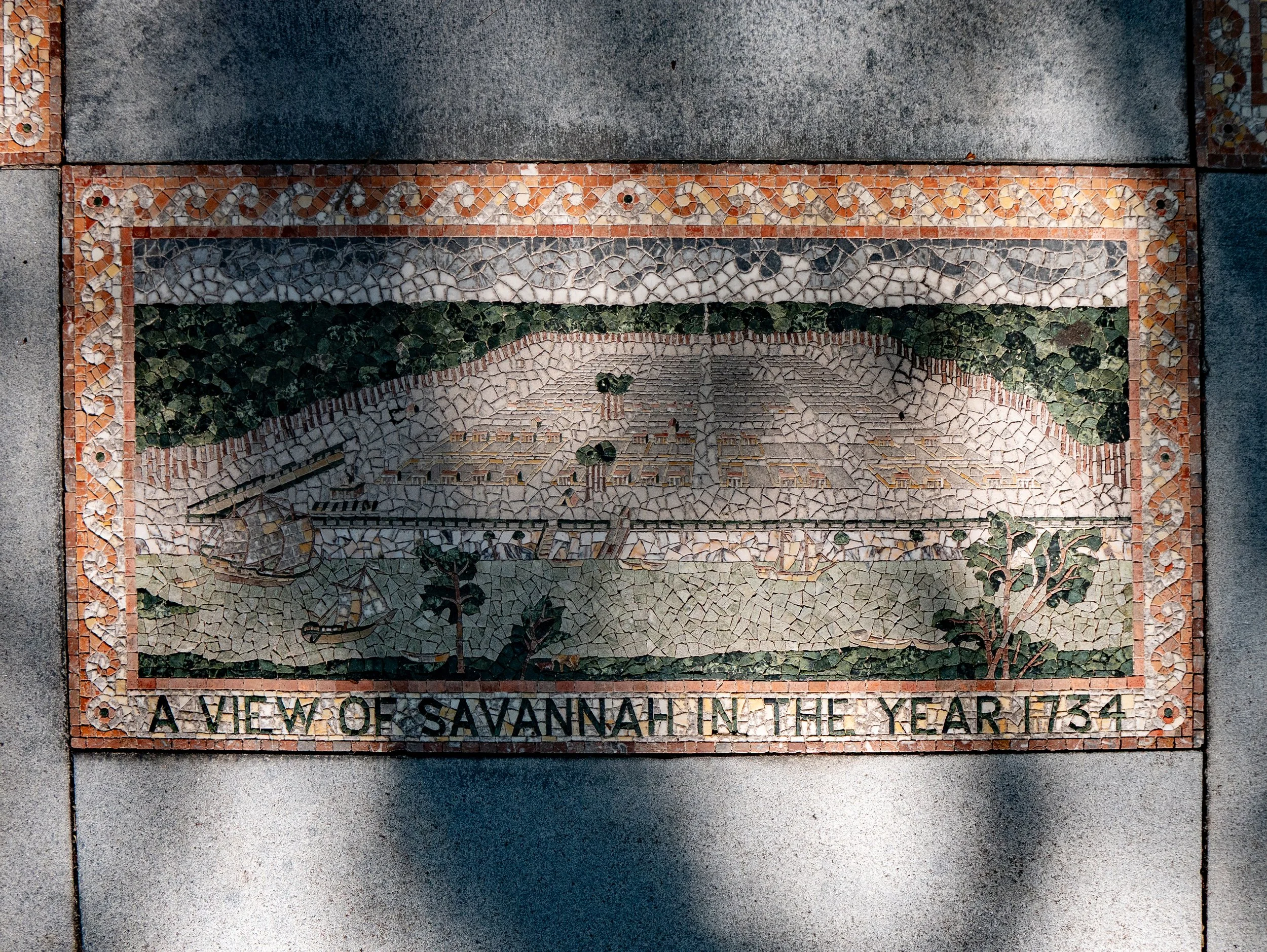
One of the sundial’s mosaic panels offers an artistic interpretation of Savannah in 1734.
Johnson Square Today
Johnson Square remains a working part of downtown Savannah. Office buildings, banks, Christ Church, shops, and city streets surround its live oaks, brick walks, monuments, benches, and fountain.
Visitors pass through on foot and by bicycle. Tour guides pause beside the historical markers. Office workers cross the square during the day, while others find shade beneath the trees or sit beside the fountain.
That continued activity matters. Johnson Square has never been frozen at one moment in history. Its purpose has evolved from the practical needs of a colonial settlement to the civic, commercial, and visitor life of a modern city.
The contrast is part of its character. Savannah City Hall rises just north of the square, its golden dome visible along the Bull Street corridor. The Greene Monument recalls the Revolution, while the sundial points back to the original city plan. Christ Church preserves the square’s religious history, and the people moving through it keep the space connected to the present.
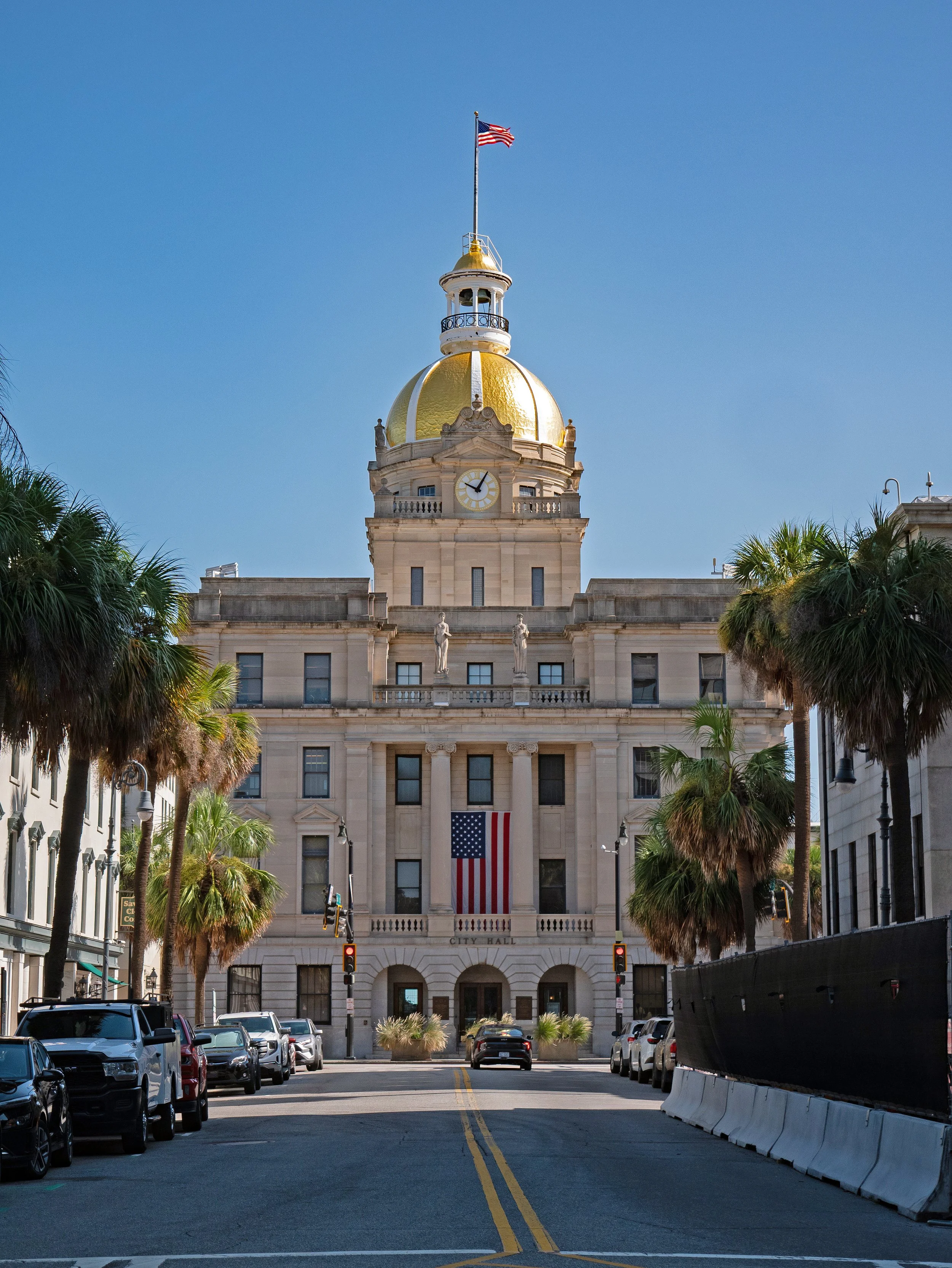
Savannah City Hall rises north of Johnson Square along the historic Bull Street corridor.
Visiting Johnson Square
Johnson Square is located on Bull Street in the heart of Savannah’s Historic District, near East Congress Street and a short walk south of City Hall.
There is no admission fee, and the square is open to the public. Allow at least 20 to 30 minutes if you want to examine the Greene Monument, read the historical markers, visit the sundial, and appreciate the surrounding architecture.
From Johnson Square, the walk south along Bull Street to Wright Square takes approximately 2½ minutes at a normal walking pace. This makes Johnson Square a natural beginning for exploring Savannah’s connected sequence of historic squares.
While visiting, look for:
The Nathanael Greene Monument and bronze relief
The Nathanael Greene historical marker
The Lafayette’s Tour marker
The Washington’s Southern Tour marker
The Colonel William Bull Sundial and surrounding mosaics
Christ Church Episcopal and its historical marker
The view north toward Savannah City Hall
The live oak canopy, brick paths, fountain, and surrounding architecture
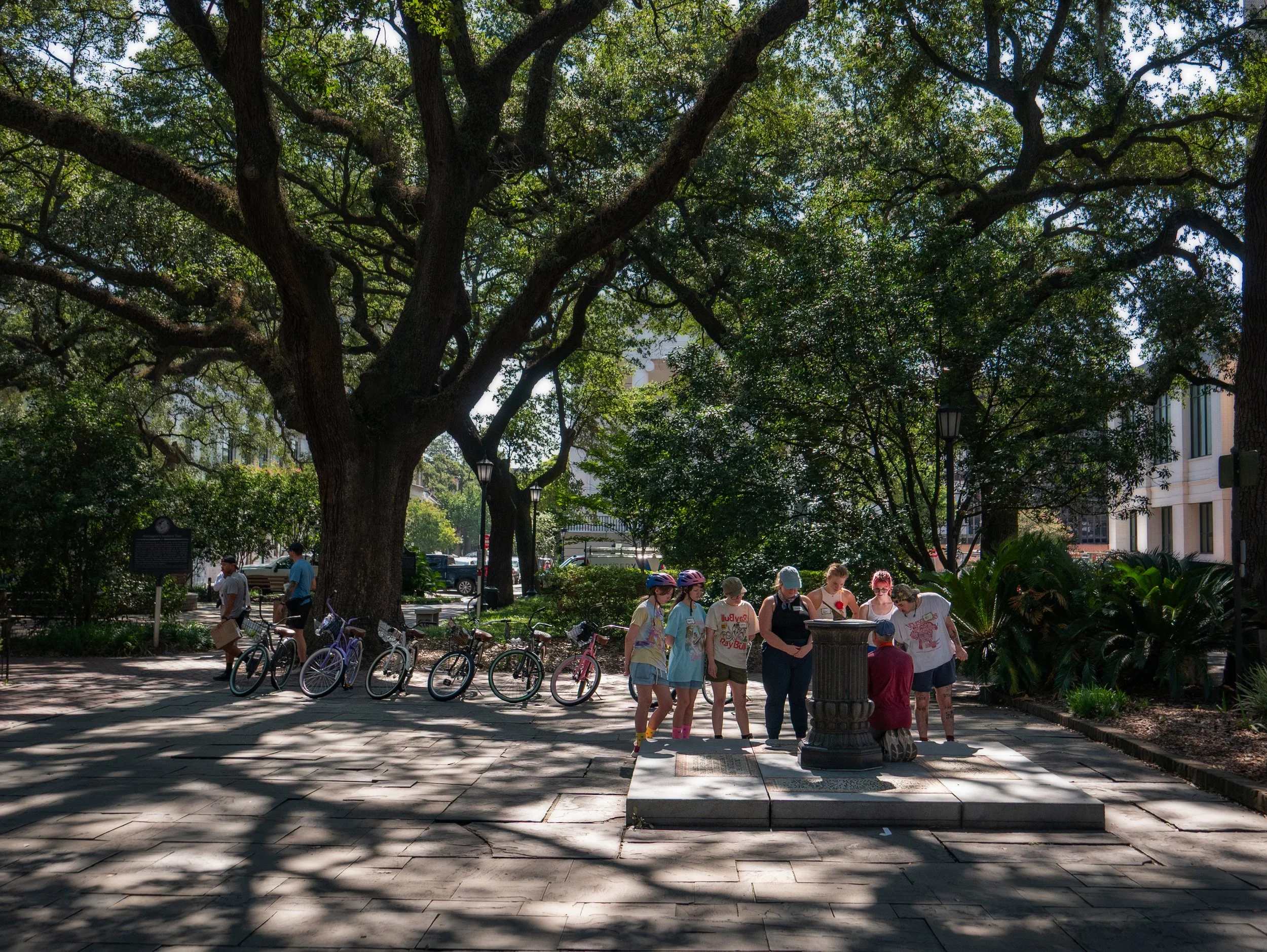
Visitors study the Johnson Square sundial during a bicycle tour through Savannah’s Historic District.
Where Savannah’s Past Remains Present
Johnson Square does not tell only one story. It contains the beginnings of Savannah’s city plan, encounters between Indigenous and colonial leaders, the development of religious life, the public reading of American independence, presidential visits, Revolutionary friendships, and generations of civic remembrance.
Some of these stories are carved into stone or bronze. Others survive in markers, documents, and the arrangement of the city itself.
Together, they make Johnson Square an ideal place to begin exploring Savannah. It is the city’s first square, but it is also something more enduring: a place where Savannah has continued to gather, remember, and move forward.
Continue exploring Savannah
Walk south along Bull Street for approximately 2½ minutes to reach Wright Square, another of Savannah’s original squares and a place connected to Tomochichi, William Washington Gordon, early colonial justice, and the continuing evolution of the city.
Sources and further reading
Historical details were checked against the City of Savannah’s Johnson Square information, the Georgia Historical Society’s Johnson Square marker, its Nathanael Greene Monument marker, the New Georgia Encyclopedia’s biography of Nathanael Greene, the Christ Church historical marker, the Washington’s Southern Tour marker, the City of Savannah’s monuments inventory, and the National Park Service’s history of Savannah’s city plan.
This Savannah Proper story was researched, photographed and visually interpreted by Savannah artist, photographer, and filmmaker Charles Maring. Original photography and visual storytelling were produced by Maring Visuals.
Photography credit for all original Johnson Square images: © Charles Maring / Savannah Proper.