Chippewa Square: Stories Beneath the Oaks
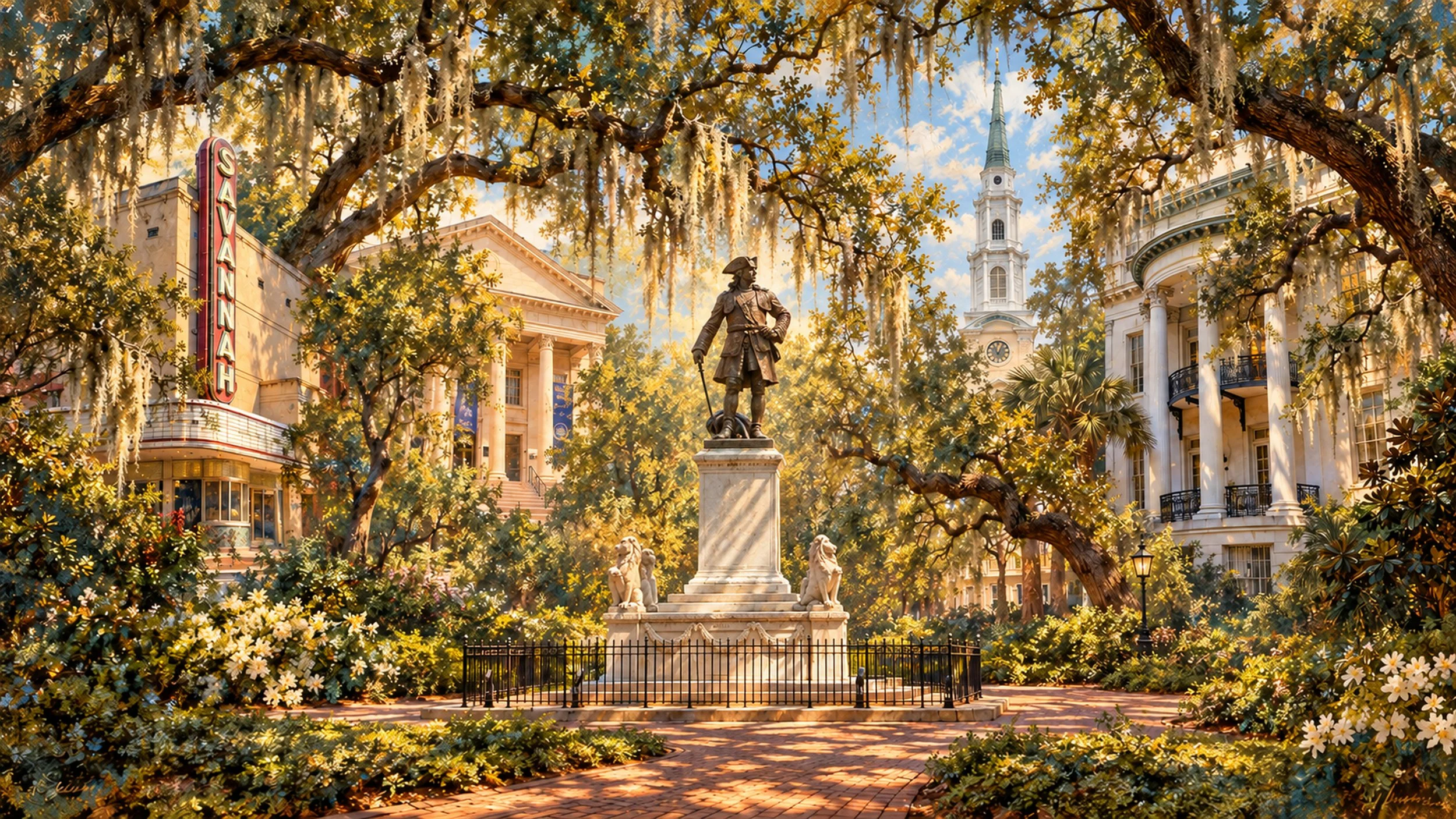
Stories beneath the oaks. An artistic interpretation of Chippewa Square inspired by Charles Maring’s photographs, weaving its historic monument and surrounding architecture into golden light.
Story and photography by Charles Maring
There is a moment in Chippewa Square when the buildings seem to retreat behind the trees. Live oak branches reach across the paths, Spanish moss hangs in loose curtains, and sunlight breaks into small patterns on the brick. Above the shrubs and shaded benches, a bronze figure stands on a pale stone pedestal. Around the edges, church columns, a theater marquee, and the windows of historic homes bring the city back into view.
The photographs accompanying this story follow those details. An inscription offers a date. A church doorway leads toward a sanctuary. Taken together, they reveal a square whose character comes from the relationship between its public space and the lives unfolding around it.
Chippewa Square rewards that kind of attention. Its most familiar image may have traveled around the world through cinema, but there is much more here to discover in the distance between one bench and the next.
A Name That Reaches Beyond Savannah
Laid out in 1815, Chippewa Square takes its name from a battle in the War of 1812. The Battle of Chippawa, fought in 1814 in what is now Ontario, provides the historical reference behind the name visitors encounter in Savannah. The square belongs to a later chapter of the city’s growth, rather than its original founding in 1733.
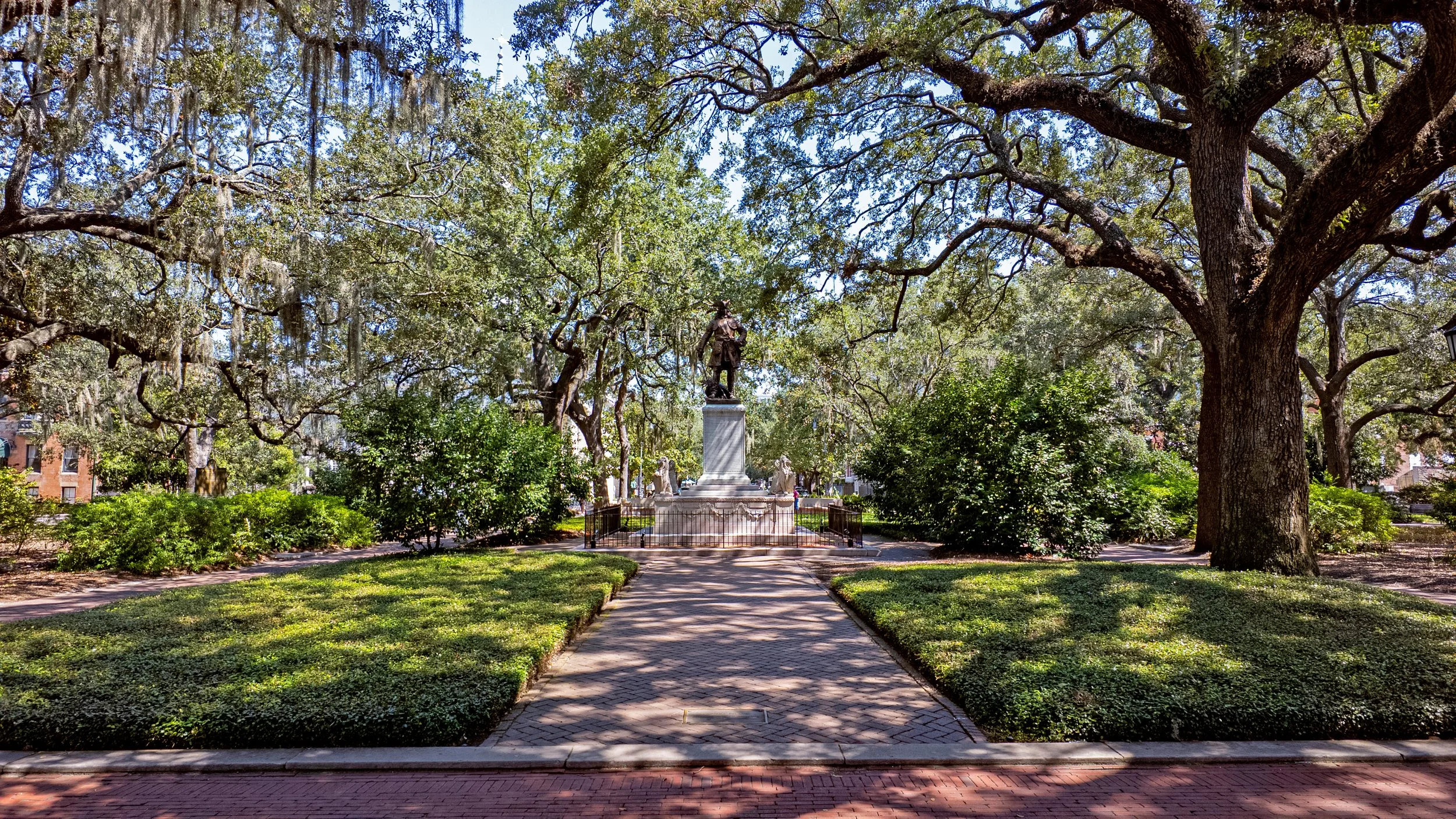
A brick path draws the eye toward Oglethorpe’s monument beneath Chippewa Square’s spreading oak canopy.
That distinction is easy to overlook beneath the trees. Savannah’s squares can feel as though they all arrived together, yet each has its own place in the city’s development. Here, a name commemorating a distant military conflict became attached to a neighborhood gathering place, surrounded over time by worship, entertainment, commerce, and domestic life.
The small plaque photographed in the brick brings that origin into focus. It asks very little of a passerby beyond a pause, but that pause changes the walk. A lovely green space becomes a place with a particular beginning.
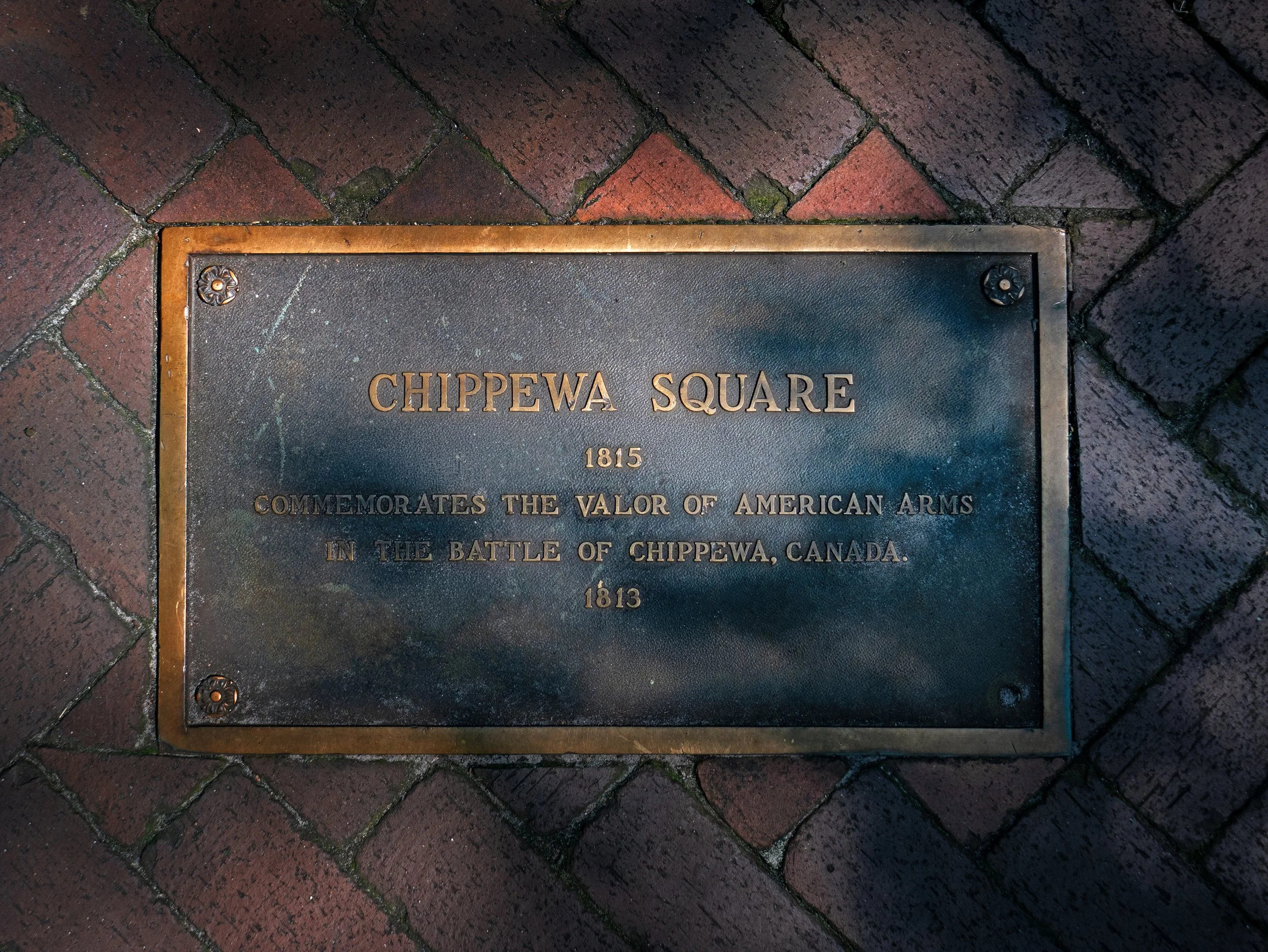
Set into the brick, a small plaque records the distant battle behind the square’s name.
Oglethorpe at the Center
James Edward Oglethorpe occupies the square’s central position, his bronze figure framed by branches and moss. The monument was unveiled on November 23, 1910, with sculpture by Daniel Chester French and architectural work by Henry Bacon. It commemorates the founder of Georgia and Savannah long after the square itself was established.
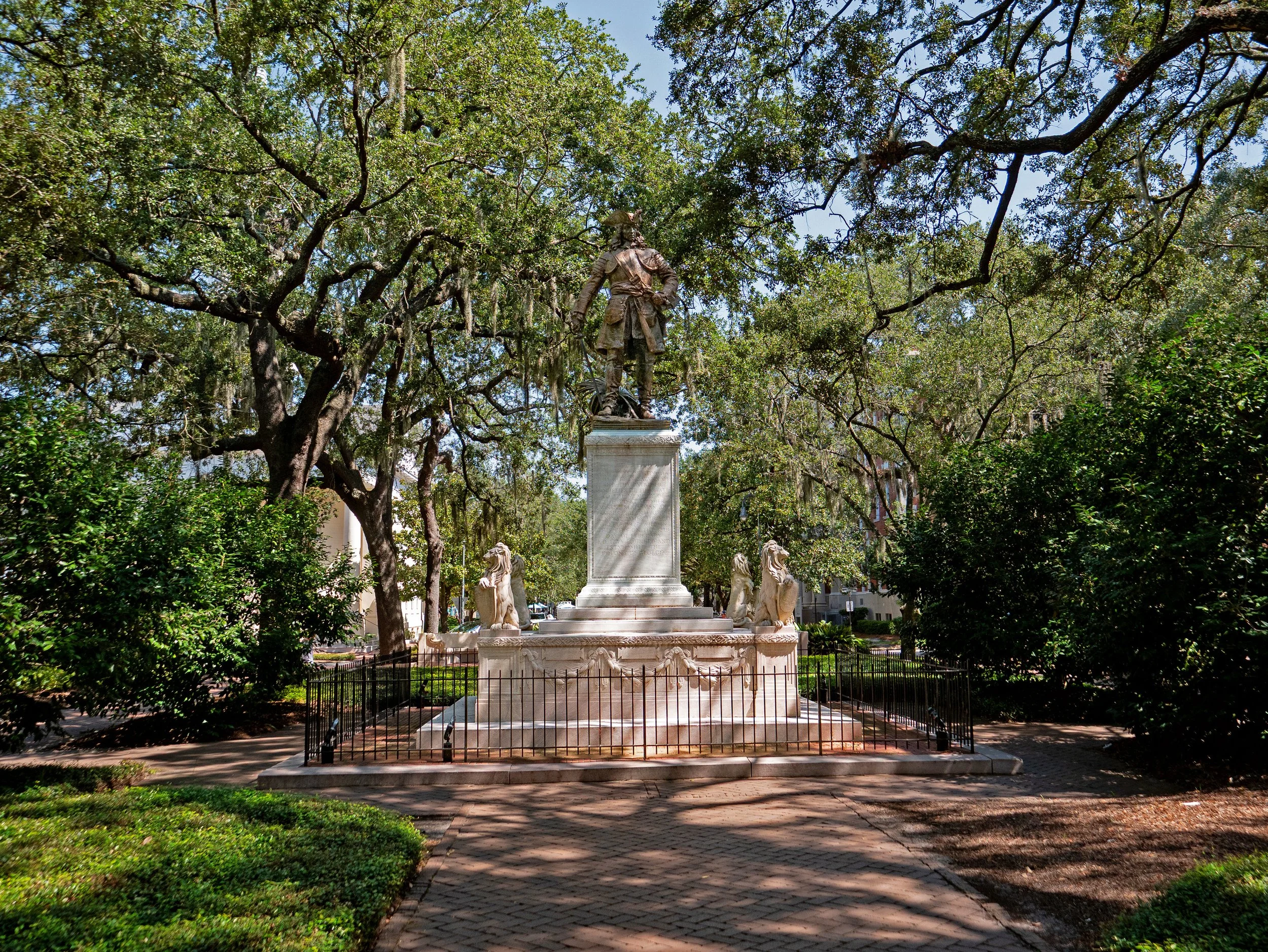
Oglethorpe’s bronze figure rises above a stone pedestal surrounded by heraldic lions.
From a distance, the monument supplies a visual anchor. Closer views reveal the lions around its base, the shields they present, and the inscriptions through which a later generation chose to describe Oglethorpe’s legacy. Walking around it changes the composition continuously. The figure emerges against sky, then leaves; the pedestal catches sunlight, then falls into shade.
There are two histories here: the life of the man being remembered and the story of the people who built a monument to him. Public memorials hold both. Their materials, language, and placement tell us something about the moment of commemoration as well as the earlier past.
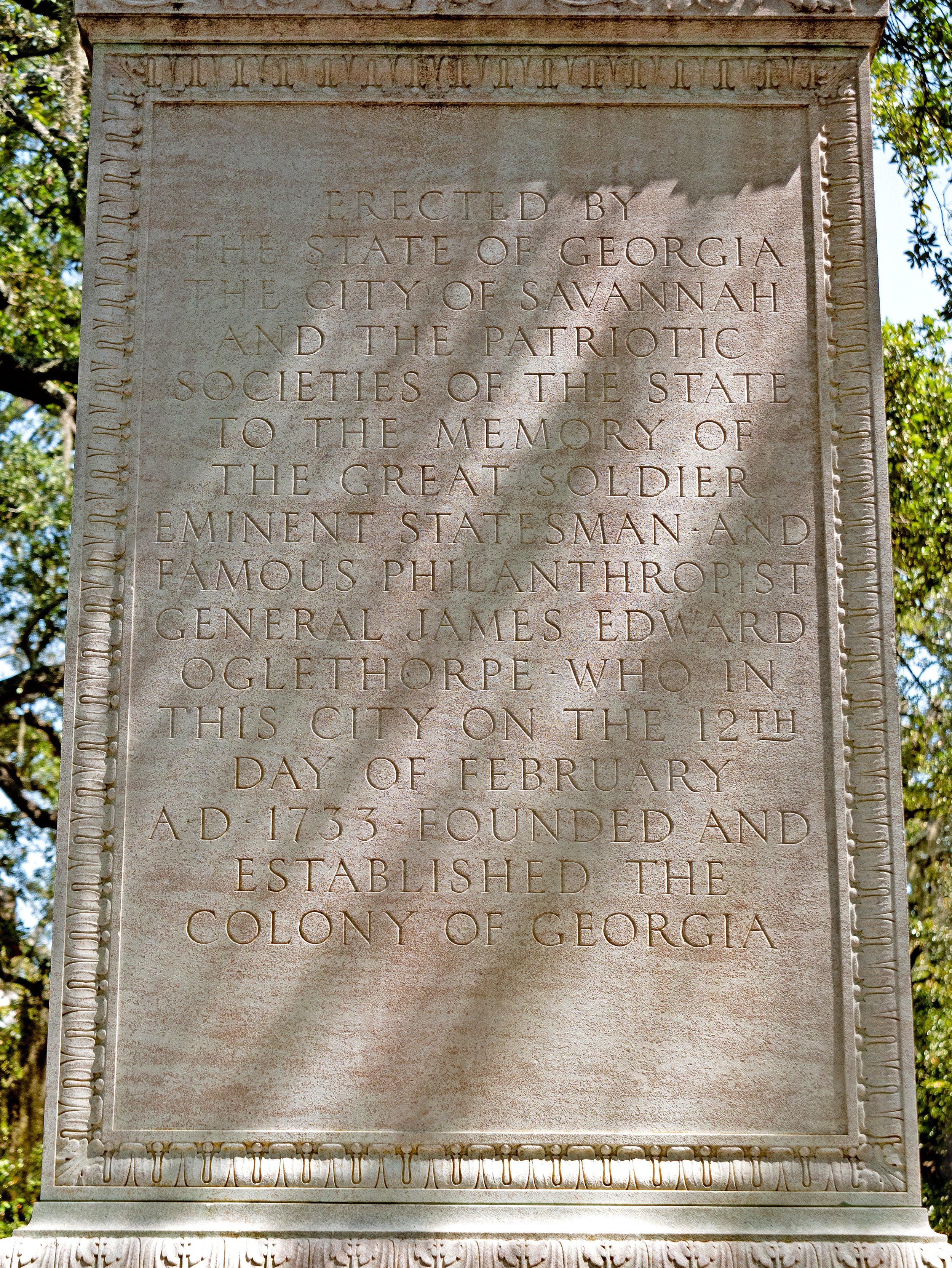
The monument’s dedication preserves the language through which a later generation remembered Georgia’s founder.
Savannah Proper has already explored the founder’s life in James Oglethorpe: The Founder of Savannah, GA and Champion of Social Justice. Here in Chippewa Square, that larger story has a physical presence, surrounded by the everyday movement of the city he helped establish.
A Theater with More Than Two Centuries of Stories
Along the square’s eastern edge, the Savannah Theatre brings an entirely different architectural voice. Its vertical sign and sweeping marquee announce a place built around audiences, anticipation, and performance.
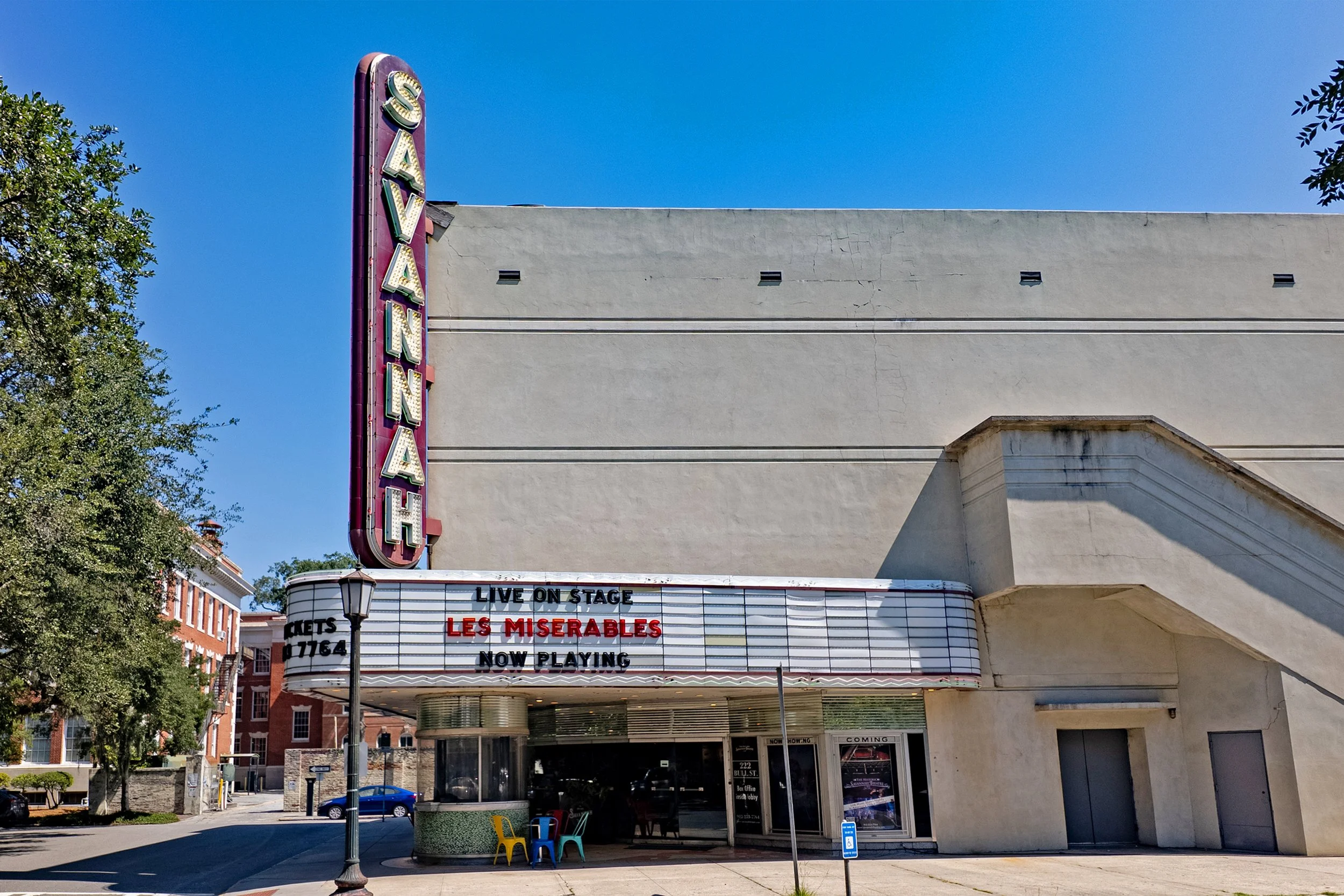
The Savannah Theatre’s vertical sign and sweeping marquee bring the language of performance to the square.
The theater opened on December 4, 1818. Its original building was designed by William Jay, but the facade visible today reflects later changes. Following a fire in 1948, it was remodeled in the Art Deco style that remains one of its most recognizable features.
That evolution matters. Historic Savannah contains buildings that have survived by changing, and the theater makes those changes visible. Its long history encompasses live performance, film exhibition, damage, rebuilding, and renewed use. The current exterior is one chapter in a much longer architectural and cultural life.
Across the street, the oak canopy softens the view. Within a few steps, the square moves from the stillness of a monument to a building whose purpose is to bring people together for a shared experience. The performers, audiences, and successive versions of this theater deserve a story of their own.
The Square That Became a Movie Memory
For many visitors, Chippewa Square is connected first with Forrest Gump. The film’s bench scenes gave this setting an extraordinary place in popular imagination, turning a patch of Savannah into the point from which a fictional life unfolded.
The bench used for filming was a prop, rather than a permanent park fixture. A bench from the production is held at the Savannah History Museum. The filming location was on the square’s north side, near Bull and Hull Streets.
There is another connection just beyond the trees. In the opening sequence, the drifting feather passes the Independent Presbyterian Church before reaching the bench. During production in 1993, the Savannah Theatre also served as wardrobe and makeup headquarters for the bench scenes.
Knowing those details makes the setting more interesting. The square, church, and theater were working parts of the production as well as elements of its backdrop. Yet a visit can continue beyond the movie connection, toward the people and buildings whose stories began long before the cameras arrived.
For more of Savannah’s life on screen, explore Movies Filmed in Savannah, GA, from Forrest Gump to other productions that have drawn inspiration from the city and surrounding coast.
Church Columns and the Quiet Beyond Them
First Baptist Church faces the square with a broad staircase, substantial columns, and a triangular pediment. In the photographs, branches interrupt the symmetry of its facade, placing the formal architecture within the less orderly shapes of the trees.
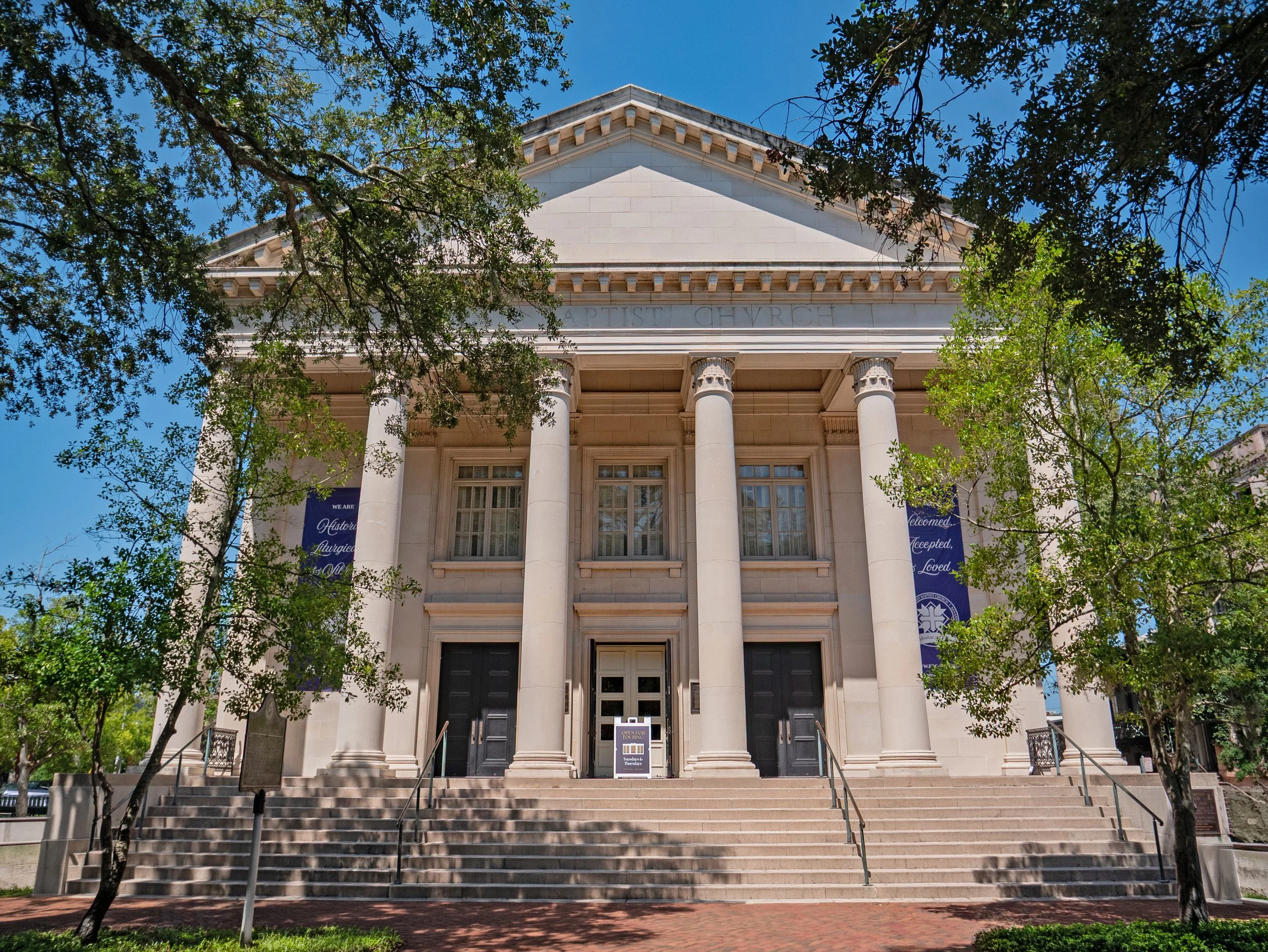
First Baptist Church faces Chippewa Square with broad steps, classical columns, and a triangular pediment.
Completed in 1833, it is identified by the New Georgia Encyclopedia as Savannah’s oldest church building. Its appearance also records later work, including the renovation noted on the historical marker beside it.
The interior photograph offers a quieter perspective. Rows of wooden pews flank a central aisle, chandeliers illuminate the sanctuary, and the organ rises above the front of the room. Outside, the church participates in the square’s public life. Inside, its scale becomes personal, measured in seats, steps, and the distance between a congregation and the place from which it is addressed.
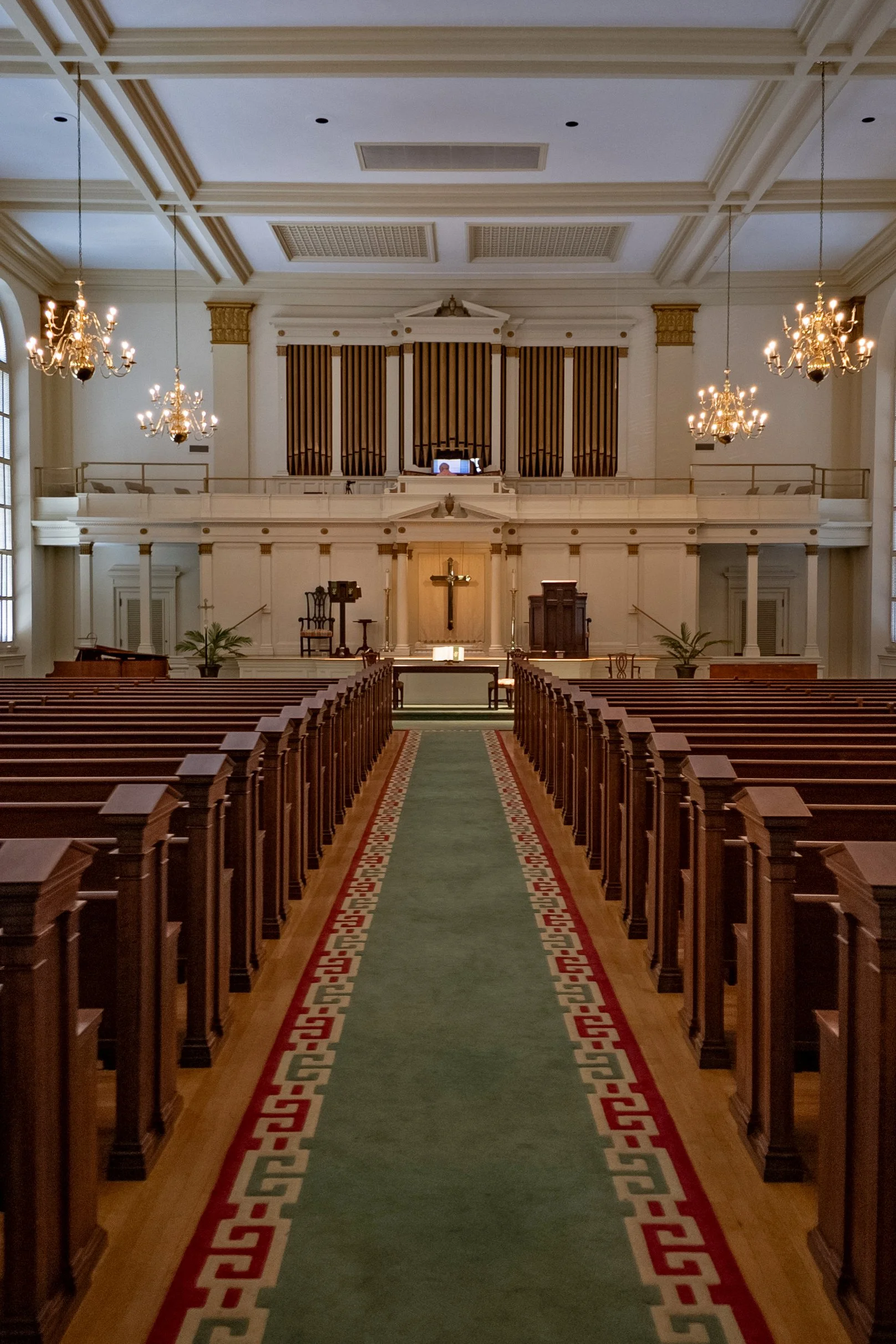
Inside the sanctuary, wooden pews and a central aisle lead toward the organ and the front of the church.
A building’s age provides an introduction. Its fuller history lies in the people who worshipped there, the decisions that shaped its architecture, and its relationship with the changing city. Those questions leave ample room to return.
A Steeple and a Musical Thread Just Beyond the Square
A short walk north along Bull Street brings the Independent Presbyterian Church into view near Oglethorpe Avenue. It stands beyond Chippewa Square’s immediate boundary, but its steeple and historical markers extend the experience of exploring this part of Savannah.
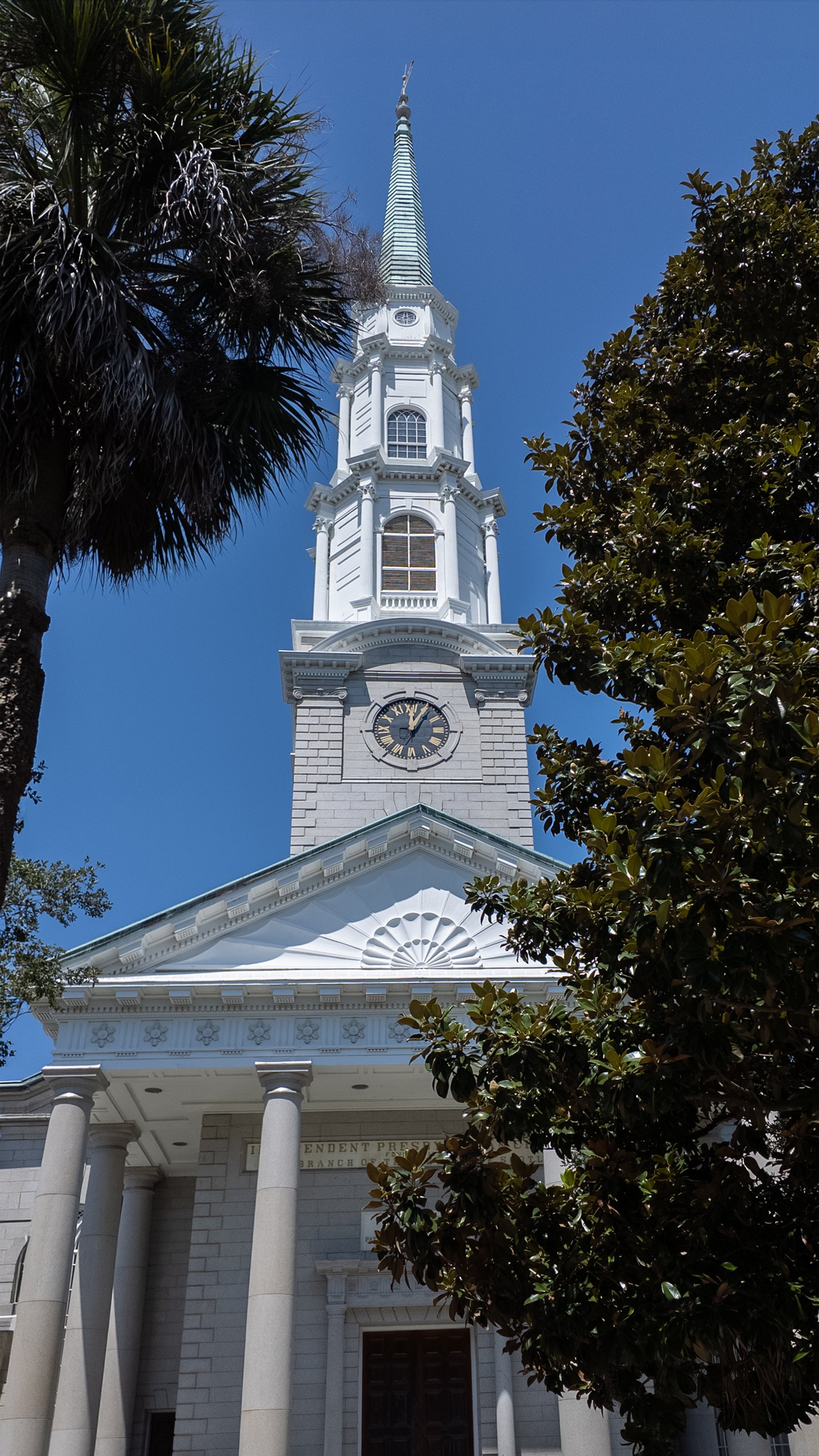
Just north of Chippewa Square, the Independent Presbyterian Church extends the walk toward Oglethorpe Avenue.
The church’s marker records an earlier building dedicated in 1819, its destruction by fire in 1889, and the completion of the present building in 1891. The rebuilt church closely followed the earlier design, preserving a familiar architectural presence through reconstruction.
Nearby, another marker introduces Lowell Mason, the composer of sacred music who lived in Savannah for approximately fifteen years. He served as the church’s organist from 1820 to 1827 and participated in the city’s religious and musical education. His later work included music for the hymn “Nearer, My God, to Thee.”
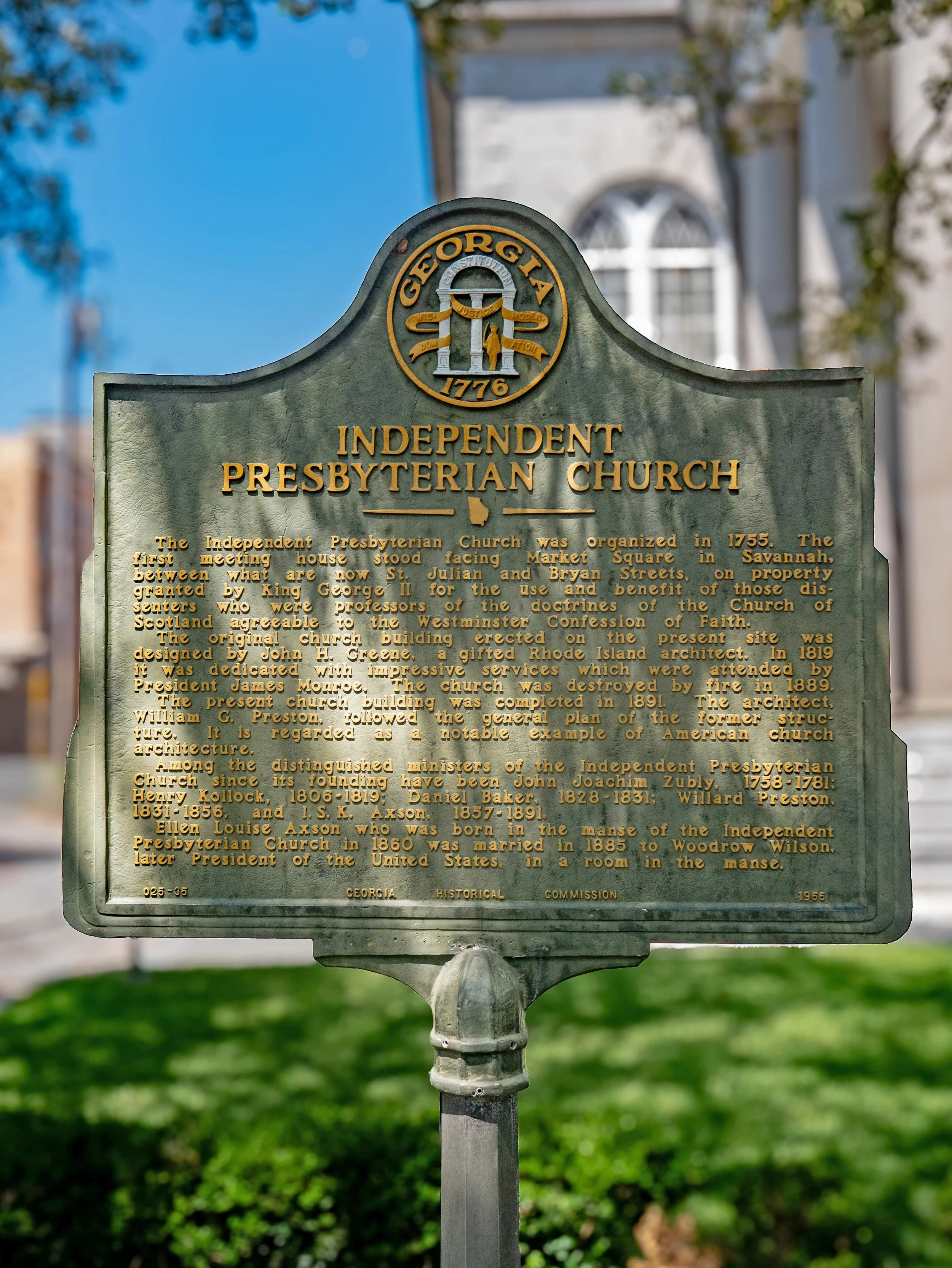
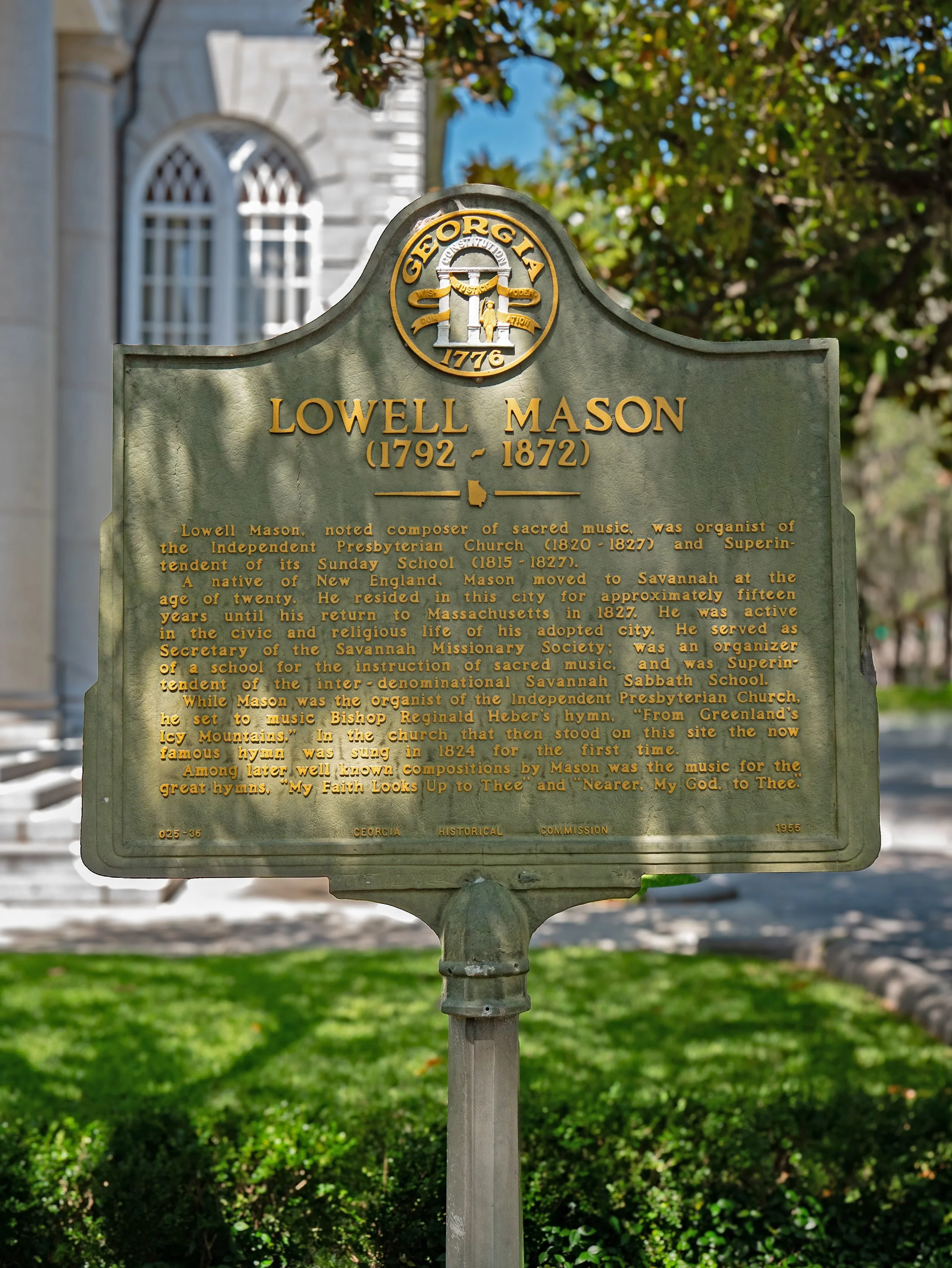
That small marker opens an unexpectedly broad subject. A walk concerned with architecture becomes a walk through musical history. It invites questions about what people sang, how they learned, and how a composer’s years in Savannah formed part of a career that reached far beyond the city.
Homes That Invite a Second Look
The residences around Chippewa Square give its perimeter a more intimate scale. Raised entrances, iron railings, shutters, and long windows suggest the routines of lives once lived behind them.
The columned Philbrick-Eastman House is among the most striking. Built in the 1840s as a Greek Revival residence, it later became commercial office space. A rehabilitation completed in 2015 preserved evidence of several periods in the building’s evolution, including an early twentieth century elevator and a midcentury vault.
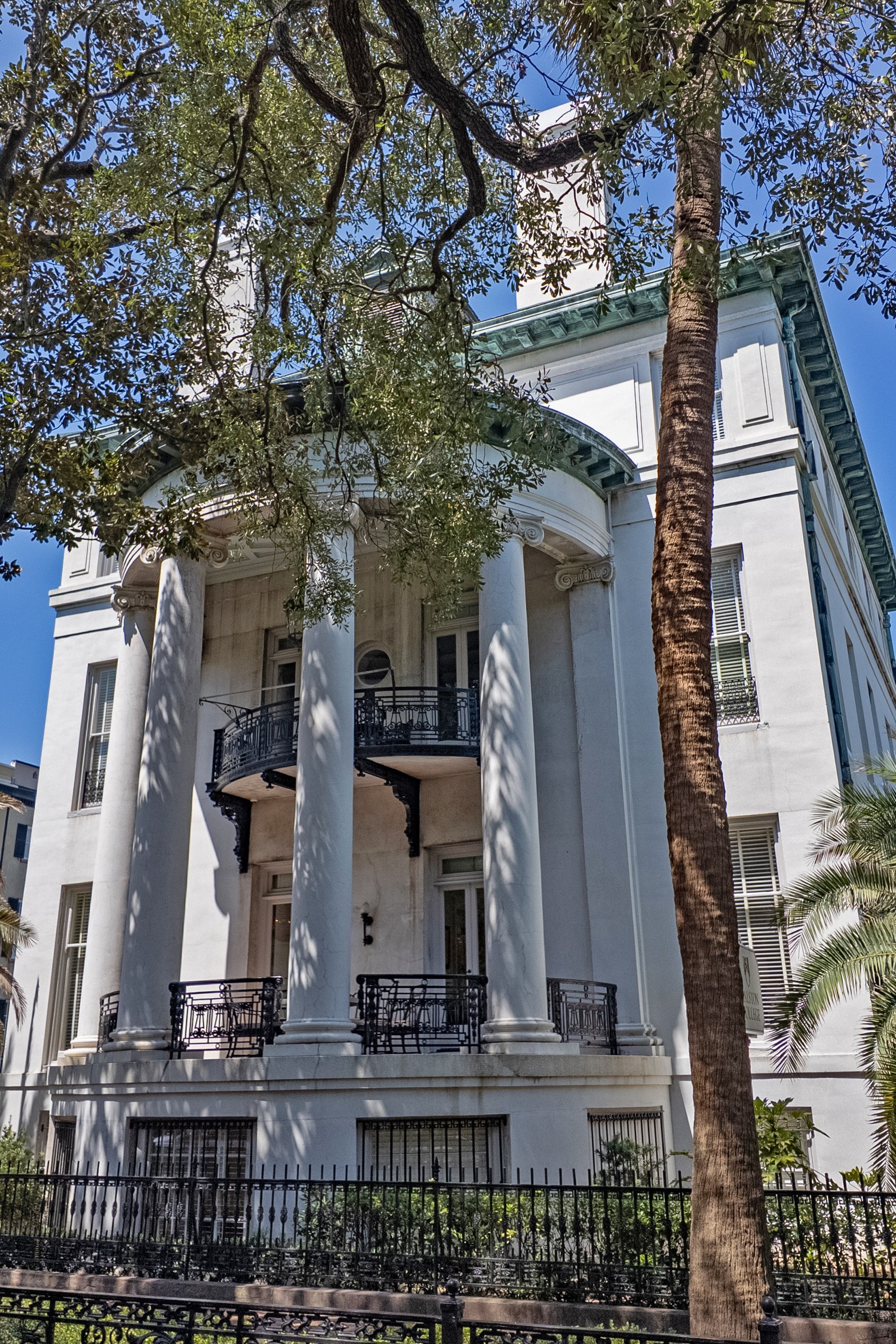
The Philbrick-Eastman House brings imposing columns and intricate ironwork to the edge of Chippewa Square.
That approach offers a useful way to understand preservation. A building can carry several eras at once. Its history includes its original design, the alterations made by later occupants, and the choices involved in giving it continued use.
Other houses in the photographs invite the same patient attention. A facade can provide the beginning of an investigation, but understanding the people associated with it requires a closer look at records, ownership, and the changing neighborhood. Around this square, there are many reasons to come back with another question.
New Memories at The Jules
The Jules is a historic mansion offering spacious guest suites on Chippewa Square. It brings the story into a more recent and personal chapter. Savannah Proper’s feature on Caitlin and Andrew’s wedding at Savannah Station began here, where the couple prepared in separate suites before their ceremony at Sacred Heart Church.
For getting ready photographs, space and light make a meaningful difference. The Jules offered room for the preparations to unfold, with ample natural light for the intimate moments before the celebration. Its furnished interiors give those photographs a residential setting, allowing a wedding morning to feel connected to the historic neighborhood outside.
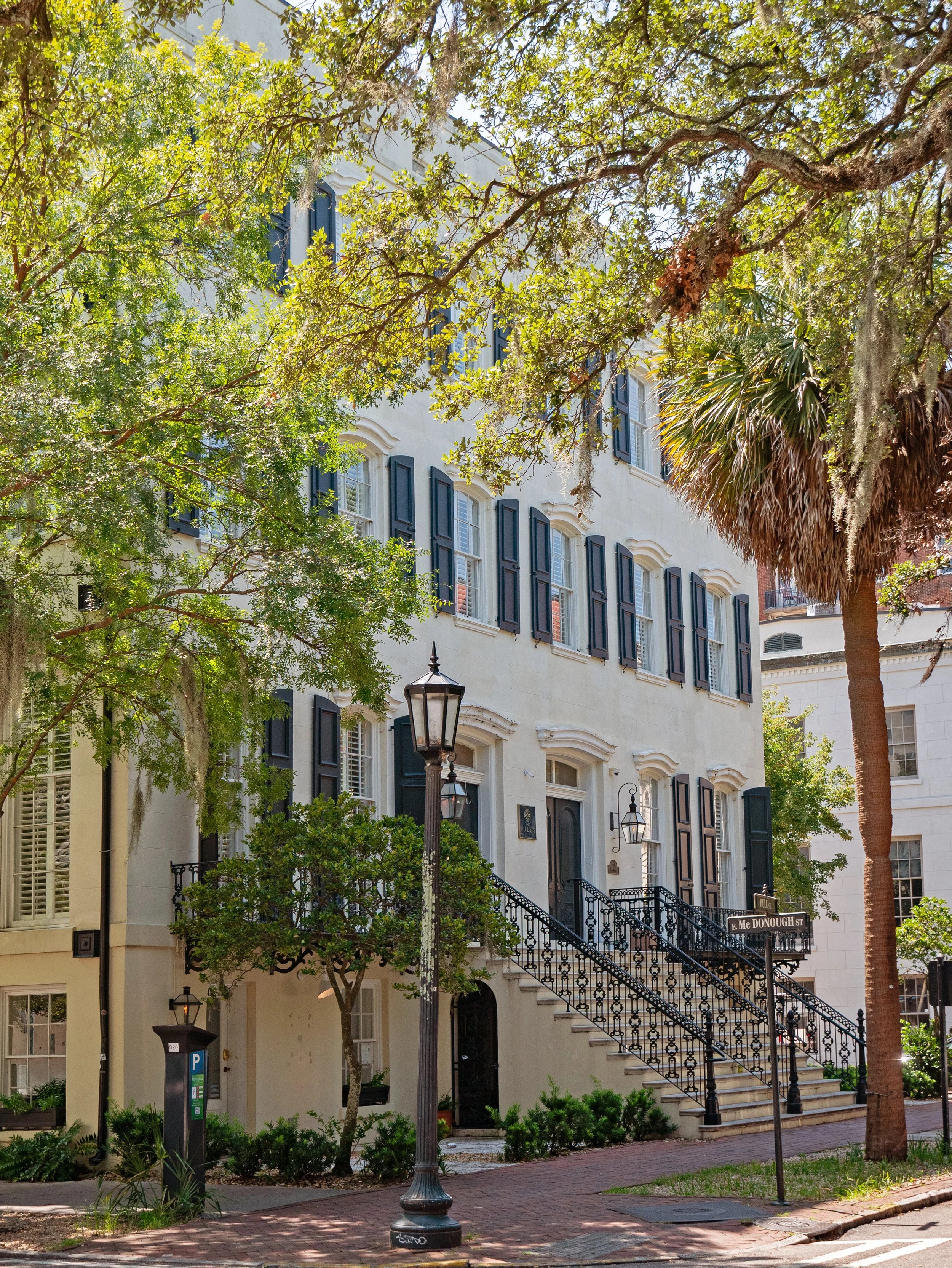
Behind The Jules’ shuttered facade, Caitlin and Andrew prepared in separate suites before their Savannah wedding.
Those early hours hold their own part of a wedding story: a dress ready to be worn, final adjustments, family nearby, and the anticipation of seeing one another. In Caitlin and Andrew’s celebration, Chippewa Square was the setting for that beginning, before the day continued to the church, Forsyth Park, and Savannah Station.
It is a reminder that historic buildings continue to acquire new meaning through the people who use them.
For couples envisioning their own Savannah celebration, explore our Elopements and Micro Weddings, with photography, an officiant, and thoughtful planning for an intimate wedding day.
Coffee, Conversation, and a Novelist’s Marker
At Gallery Espresso, the corner storefront brings the square back to the scale of an ordinary day. The photograph places it beneath the trees, at an intersection where a walk can turn into a pause over coffee.
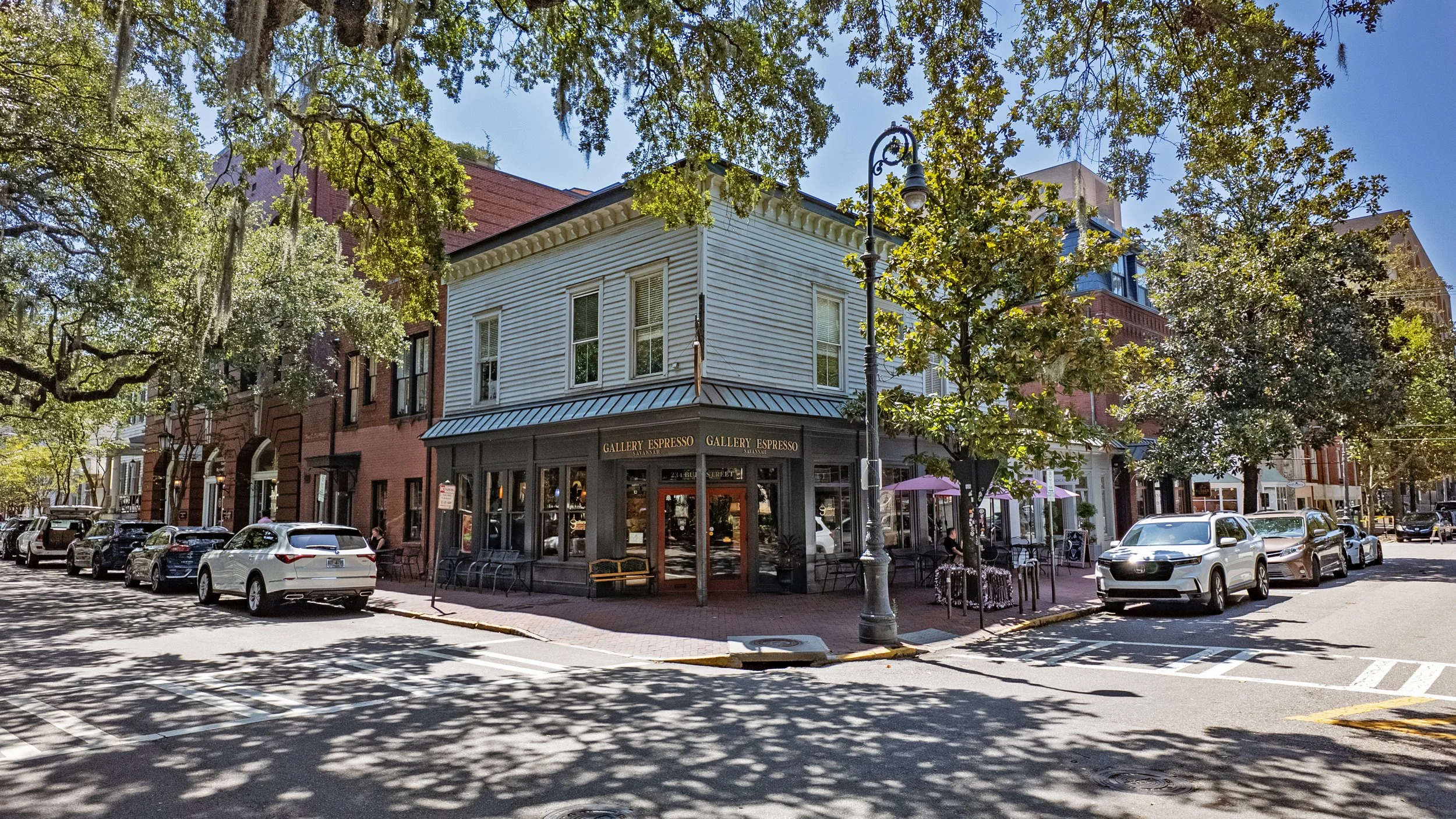
Gallery Espresso offers a place to pause as the square’s architectural walk returns to the rhythm of an ordinary day.
Nearby, the marker for Dr. William Alexander Caruthers introduces another kind of storyteller. A physician and novelist, Caruthers moved to Savannah in 1837 and participated in its civic life. He was among the founders of the Georgia Historical Society, and his historical novel The Knights of the Golden Horse-Shoe was published in Savannah in 1841.
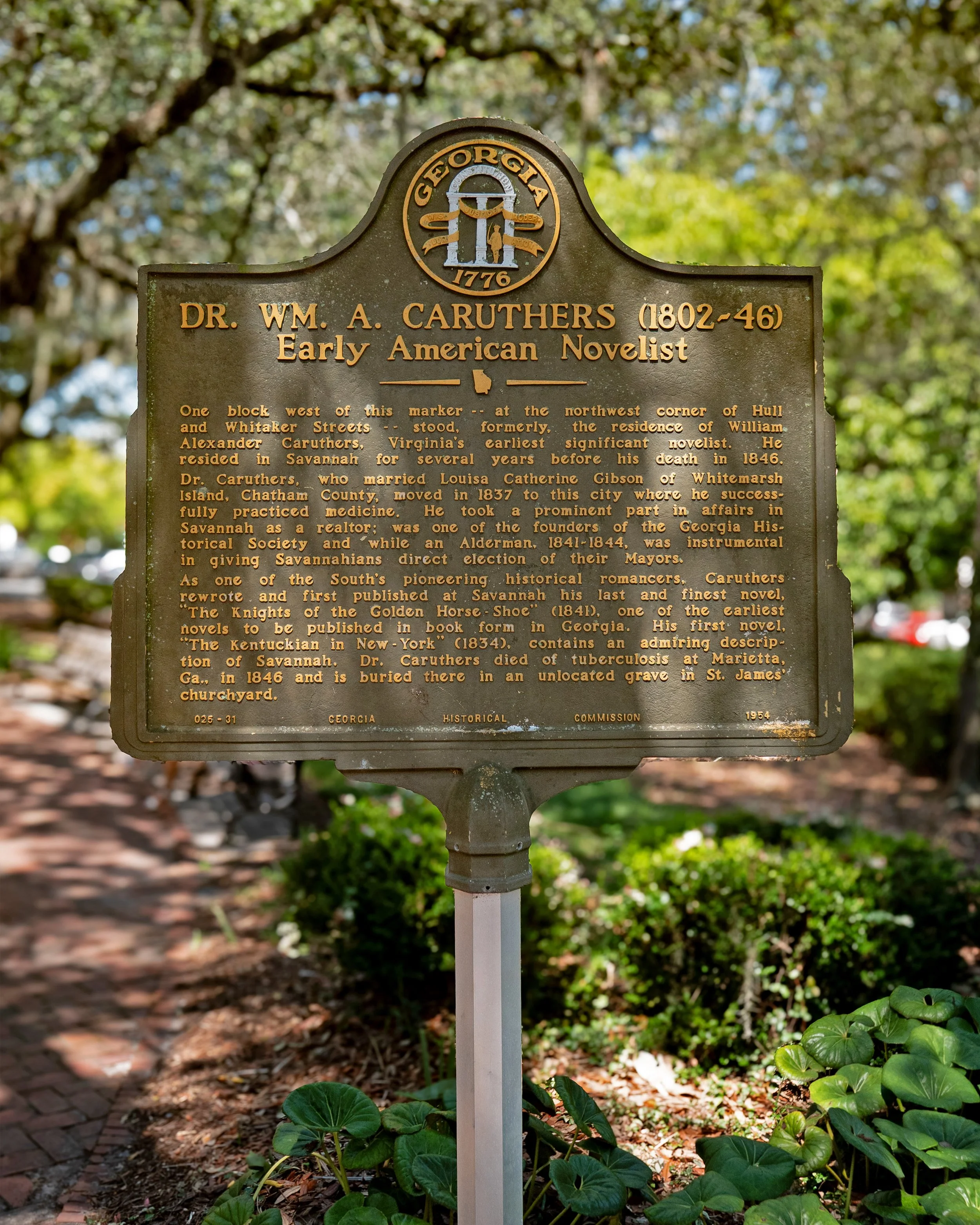
The Caruthers marker points toward a literary life and a former residence beyond the square.
His marker also points beyond itself, identifying the former location of his residence one block west at Hull and Whitaker Streets. It makes an important distinction between the place where a person is commemorated and the place where that person lived.
Reading it expands the map. The square becomes a starting point for following a life into neighboring streets, books, and public records. That is often how the most rewarding discoveries in Savannah begin.
Following the Next Story
Chippewa Square can be crossed quickly, but the photographs offer reasons to linger. Look upward into the moss. Circle the monument. Notice the theater’s facade, then the church columns across the way. Read a marker all the way to its last line.
Each detail leads somewhere. The theater opens toward a history of performance. The churches lead toward congregations, architecture, and music. The houses invite a closer examination of the families and workers who shaped them. Even a familiar movie location becomes richer when understood alongside the neighborhood that made it possible.
These are threads Savannah Proper will continue to follow. For now, they meet beneath the oaks of Chippewa Square, where the past remains visible and new stories are still taking place.
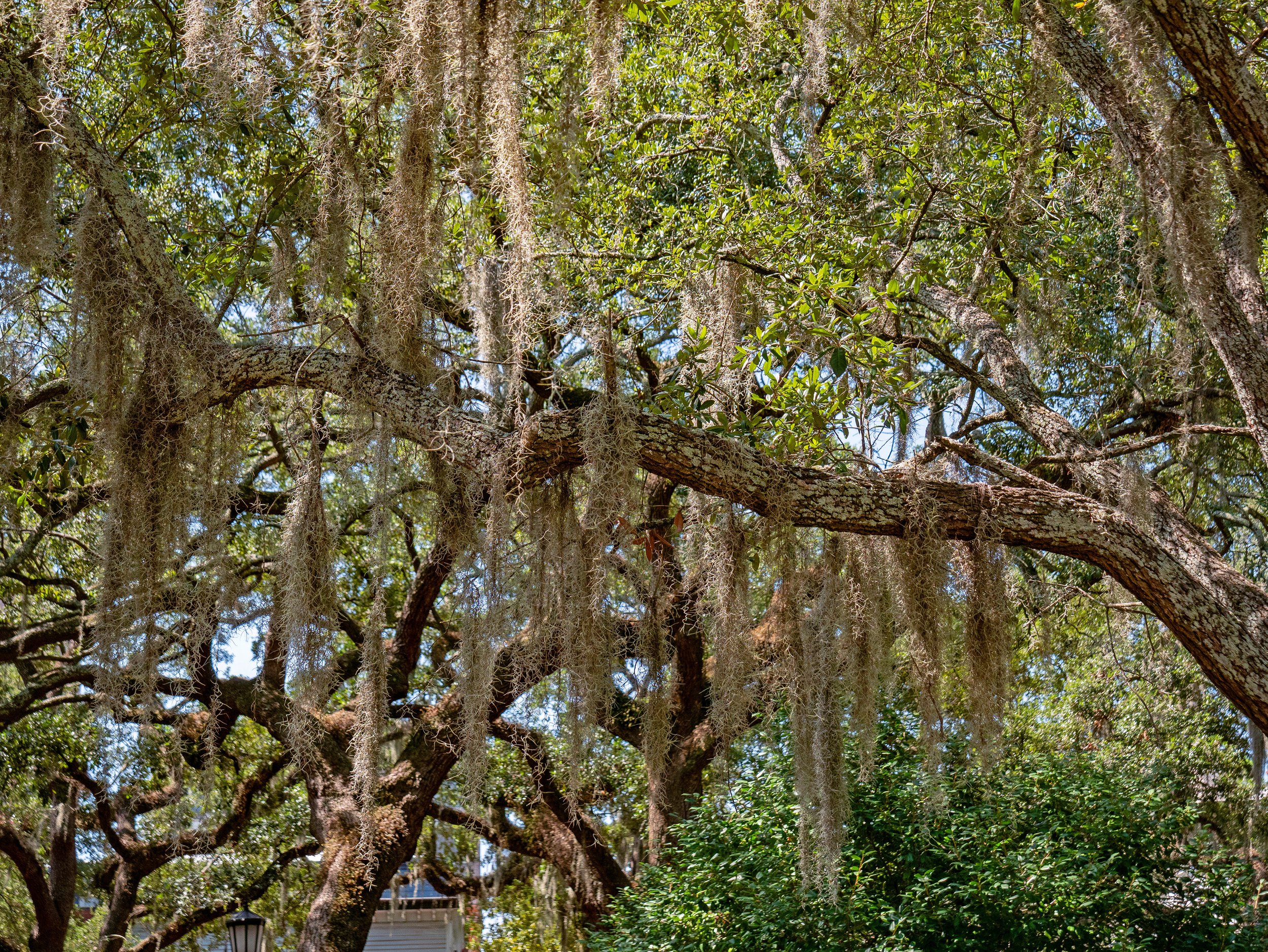
Above the monuments and surrounding buildings, the oak canopy gives Chippewa Square its lingering sense of place.
Charles Maring brings this story to light through photography and a closer look at the places and people that shape Savannah. All photographs accompanying this feature are by Charles Maring.
Sources and Further Reading: