Wright Square: Where Savannah Remembers, Forgets, and Remembers Again
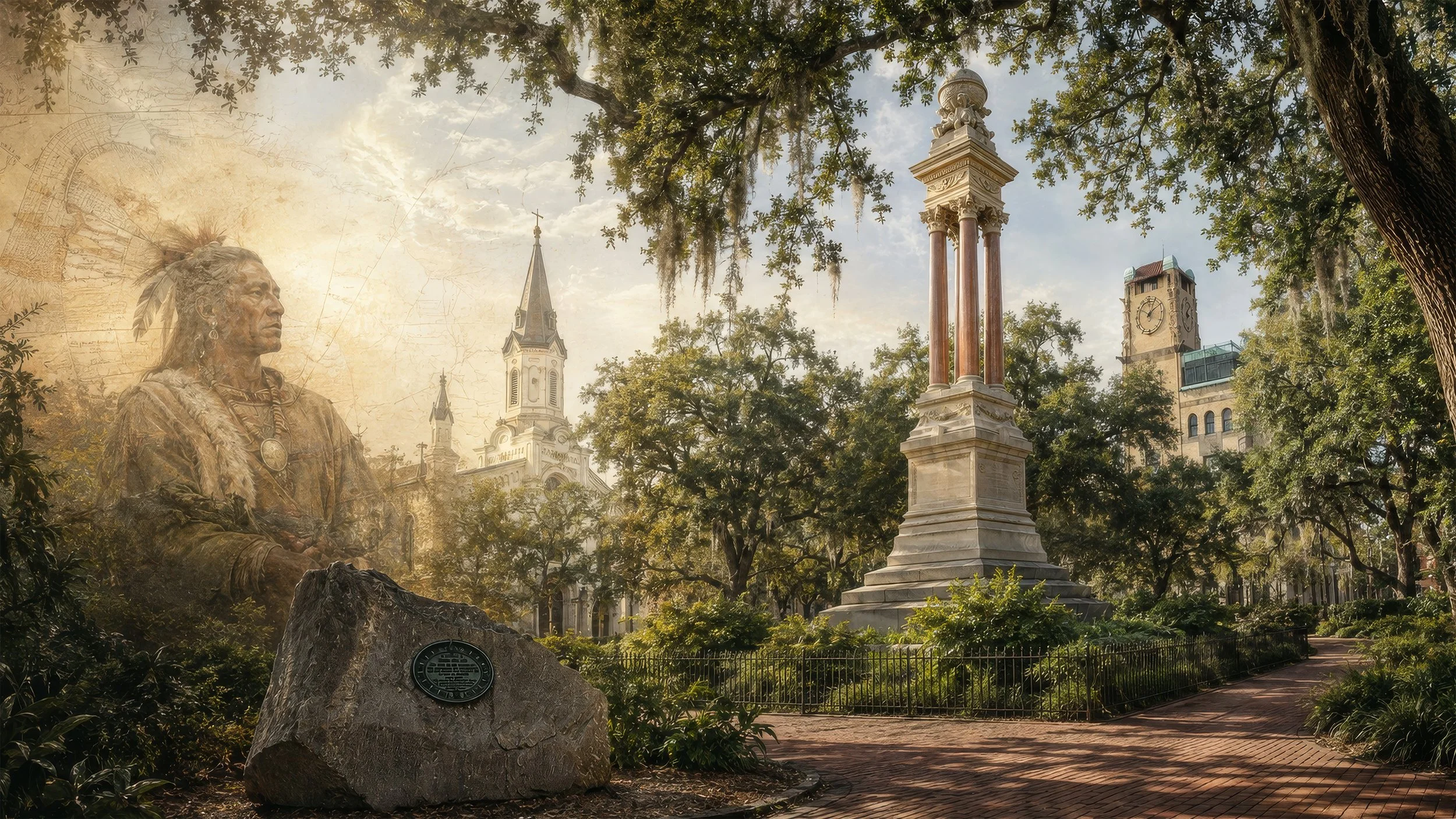
Wright Square holds centuries of Savannah history beneath its live oaks, from the legacy of Tomochichi to the Gordon Monument at its center. Artwork imagined by Charles Maring of Maring Visuals.
In the heart of Savannah’s Historic District, Wright Square holds the intertwined stories of Tomochichi, William Washington Gordon, faith, law, commerce, and the city’s evolving memory.
Story and photography by Charles Maring
Johnson Square and Wright Square sit only a few minutes apart on foot, yet they occupy distinct places in Savannah’s story.
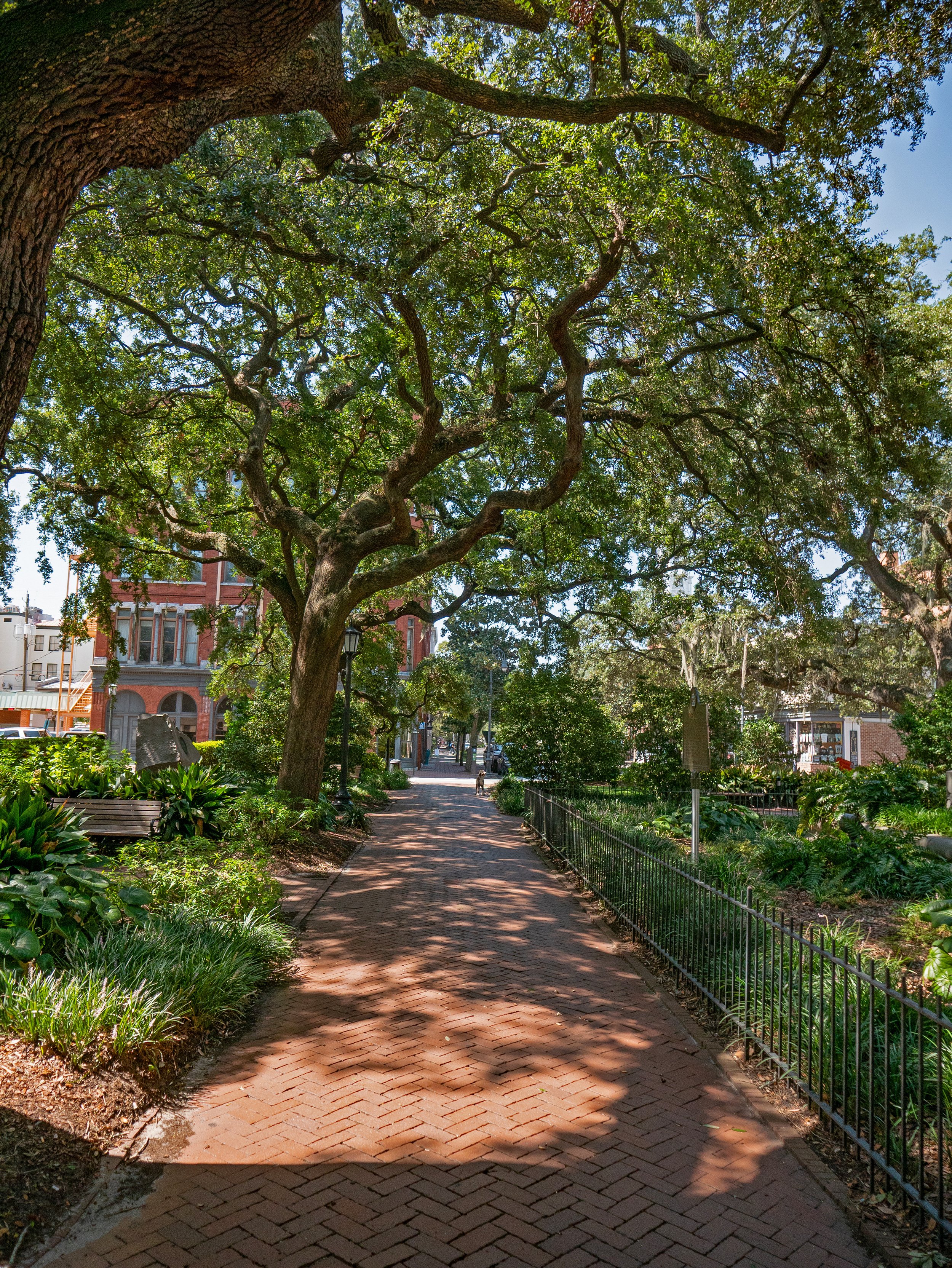
Brick paths lead through Wright Square beneath a canopy of mature live oaks.
Johnson Square feels expansive and civic, its open lawns arranged around the monument to Nathanael Greene. Wright Square feels more intimate. Here, live oaks gather closely over brick walkways, Spanish moss drifts between the branches, and the surrounding buildings seem to press history inward.
At the center rises the monument to William Washington Gordon, its four red-granite columns lifting an ornate stone canopy above the square. Nearby, a large granite boulder marks the burial place of Tomochichi, the Yamacraw leader whose alliance with James Oglethorpe helped make the founding of Georgia possible.
The two memorials stand only a short distance apart, yet they represent very different chapters in Savannah’s history. One commemorates nineteenth-century commerce and the arrival of the railroad. The other attempts to restore the memory of a Native leader whose original monument disappeared long ago.
That tension makes Wright Square one of Savannah’s most revealing public spaces. It is a place where the city remembers, forgets, and remembers again.
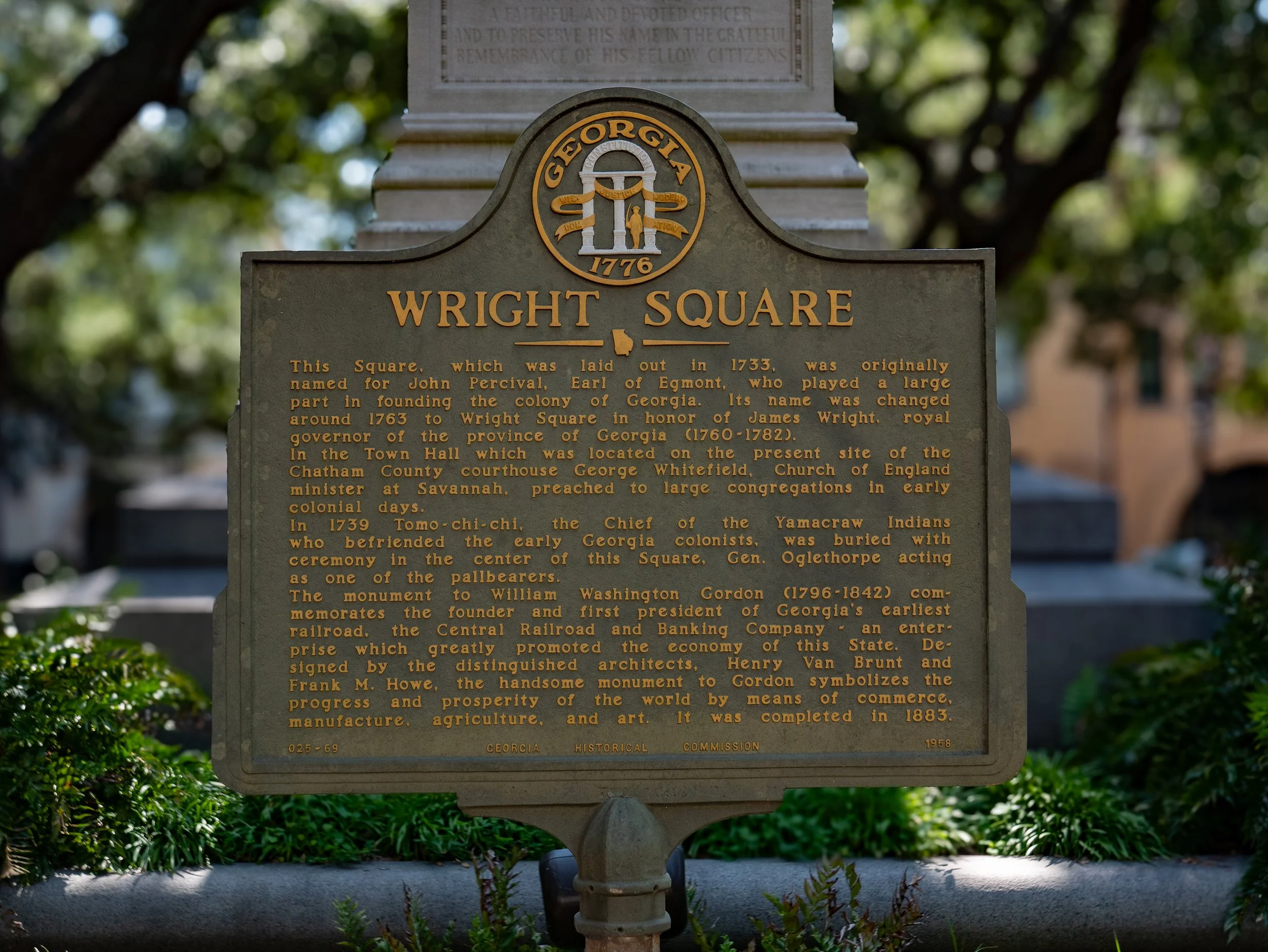
The Wright Square historical marker recounts the square’s origins, Tomochichi’s burial, and the construction of the Gordon Monument.
A Square Older Than Its Name
Wright Square was one of the four original squares laid out in 1733 as part of Oglethorpe’s plan for Savannah.
It was first called Percival Square in honor of John Percival, Earl of Egmont, a British statesman and supporter of the Georgia colony. Around 1763, it was renamed for James Wright, the last royal governor of Georgia.
The square quickly became part of Savannah’s civic and religious life. An early town hall and courthouse stood nearby, and the surrounding area became a setting for public meetings, worship, legal proceedings, and trade.
Wright Square has therefore never been merely ornamental. From the colonial era forward, it has stood at the intersection of authority, belief, commerce, and public memory.
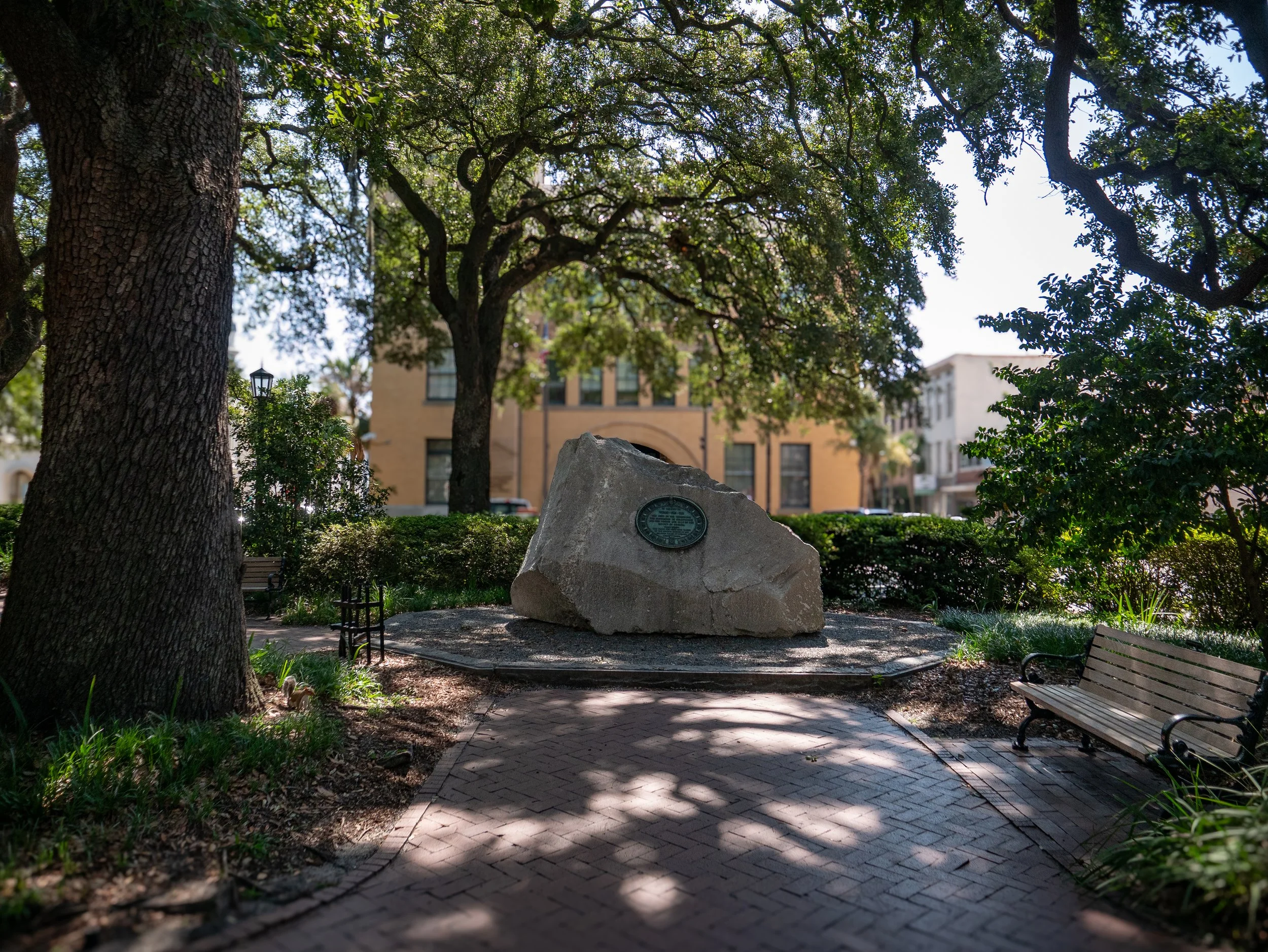
A granite boulder placed in 1899 marks the remembered burial place of Yamacraw leader Tomochichi.
Tomochichi and the Founding of Georgia
The oldest and most consequential story in Wright Square belongs to Tomochichi.
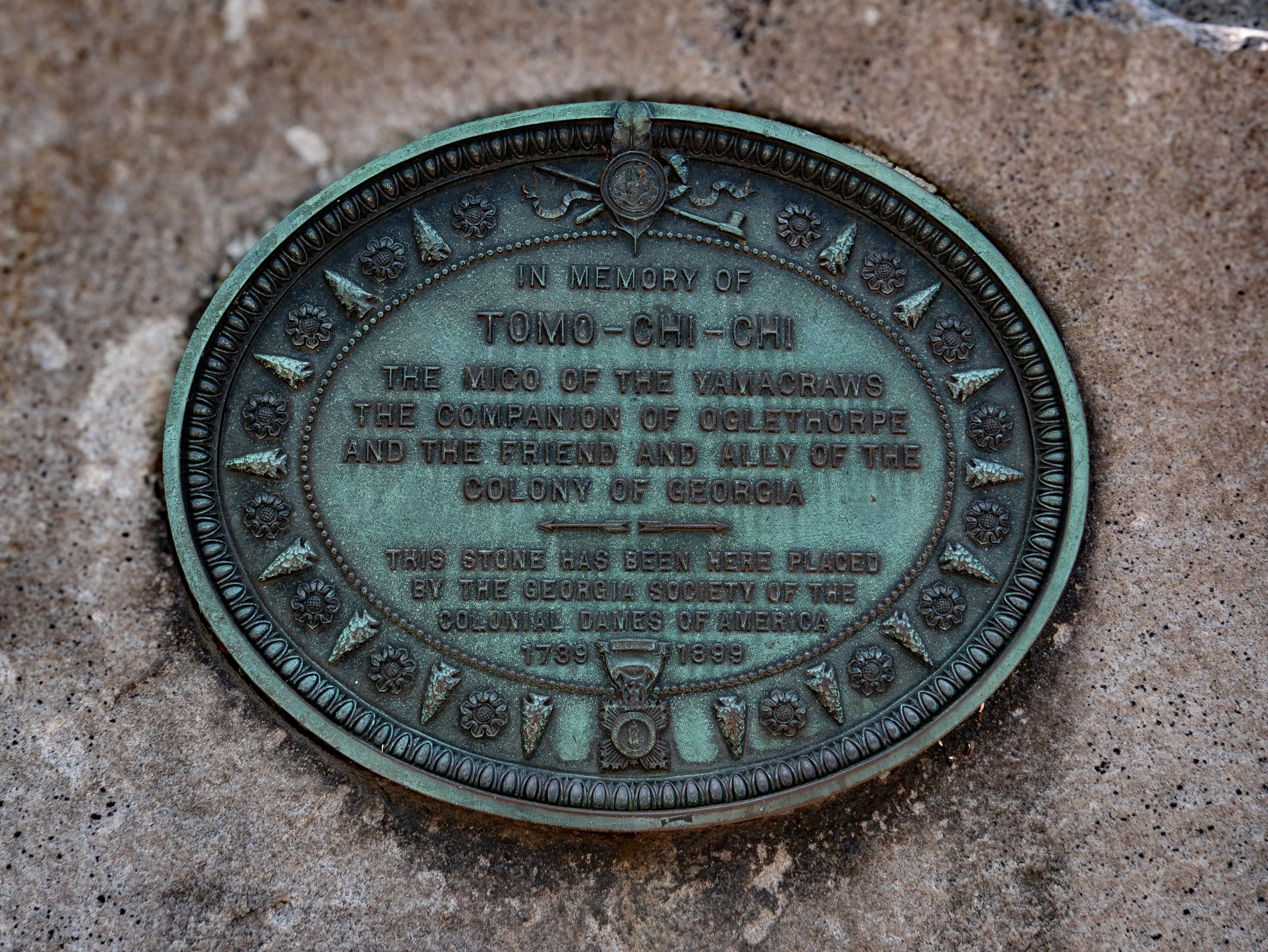
The bronze plaque honors Tomochichi as mico of the Yamacraw and an ally in the founding of Georgia.
As mico, or leader, of the Yamacraw community, Tomochichi played an essential role in the establishment of Savannah. Working with Mary Musgrove, who served as interpreter and cultural intermediary, he negotiated with Oglethorpe and allowed the new settlement to be established along the Savannah River.
The relationship between Tomochichi and Oglethorpe became foundational to the early colony. Tomochichi later traveled to England with members of his family and a Yamacraw delegation, where he was received by King George II.
When Tomochichi died in 1739, he was brought to Savannah and buried in the center of what is now Wright Square. He received British military honors, and Oglethorpe reportedly served as one of his pallbearers.
A stone pyramid once marked the grave, but that memorial eventually disappeared. Its last known public reference dates to 1759, and the circumstances of its removal remain uncertain.
The disappearance left Wright Square with an absence at its center: the burial place remained, but its most visible marker had been lost.
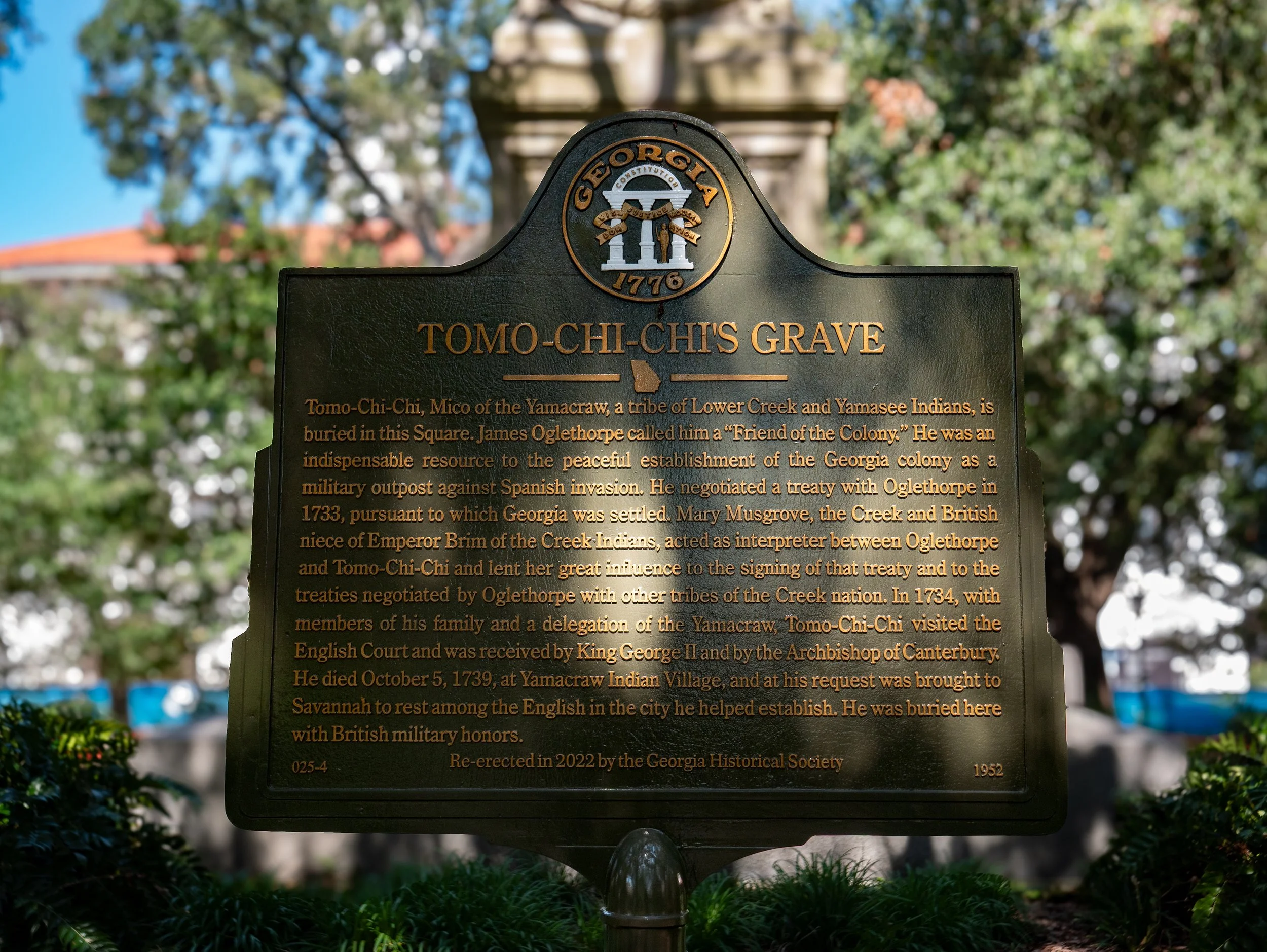
A Georgia historical marker tells the story of Tomochichi’s leadership, diplomacy, and burial in Wright Square.
How Memory Changes Shape
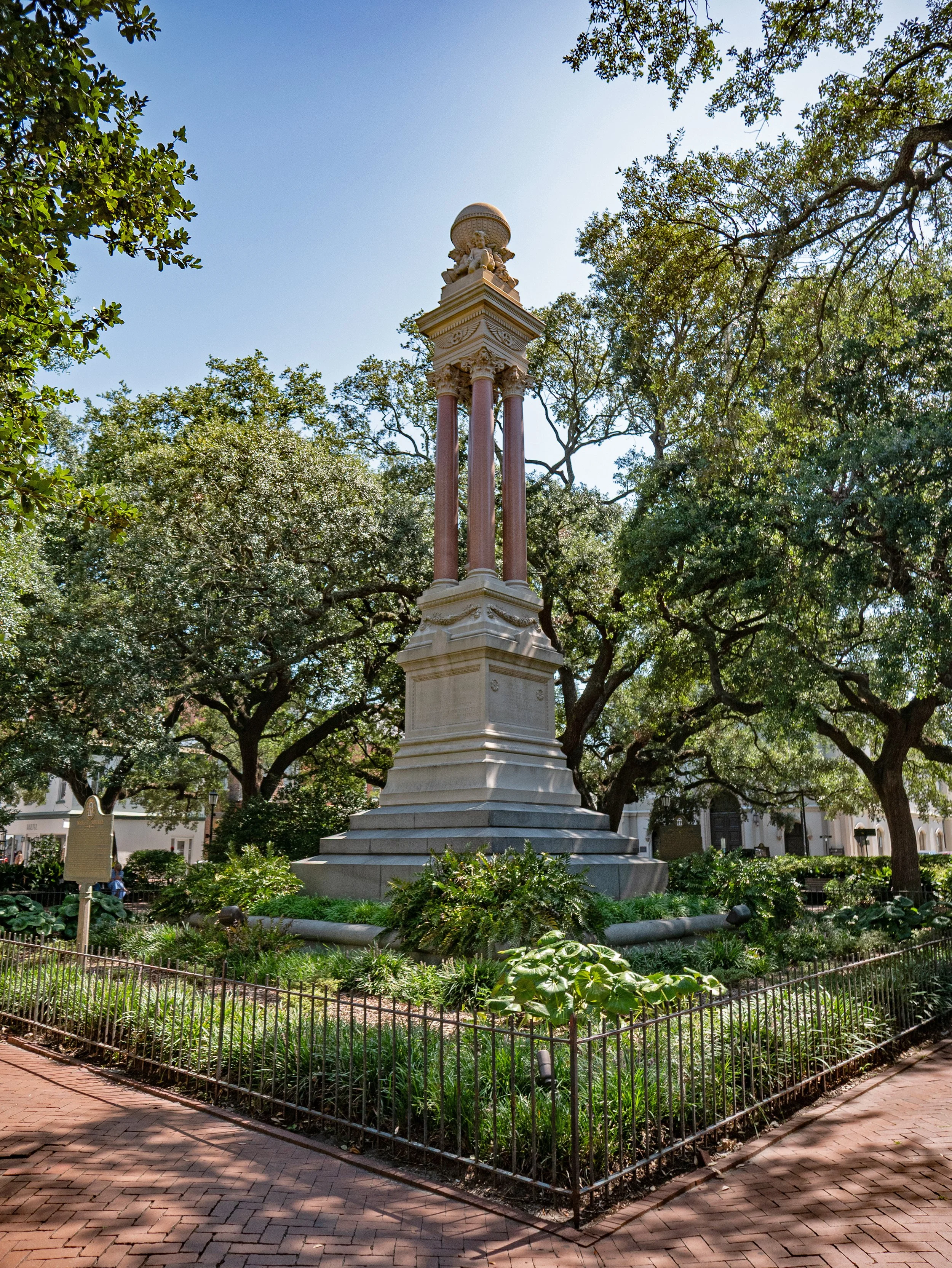
Completed in 1883, the Gordon Monument commemorates railroad pioneer William Washington Gordon.
Public memory is rarely permanent. It changes as cities change, shaped by the values and priorities of each generation.
A mound was created in Wright Square in 1871 and was long associated with Tomochichi’s grave. Research by the Georgia Historical Society, however, indicates that this was not the original colonial memorial. The mound was removed in 1882 as preparations began for the monument to William Washington Gordon.
In 1899, the Georgia Society of the Colonial Dames of America placed a large granite boulder in the square to restore a visible memorial to Tomochichi. A bronze plaque identifies him as the mico of the Yamacraws, a companion of Oglethorpe, and a friend and ally of the Georgia colony.
A second historical marker now provides additional context about his leadership, diplomacy, journey to England, and burial in Savannah.
The boulder is intentionally modest beside the soaring Gordon monument. Its presence nevertheless carries enormous weight. It acknowledges that the story of Savannah did not begin with European settlers alone. It began through negotiation, alliance, translation, and the decisions of Native people already living on the land.
A Monument to Motion
The dominant structure in Wright Square commemorates William Washington Gordon, the founder and first president of the Central Railroad and Banking Company of Georgia.
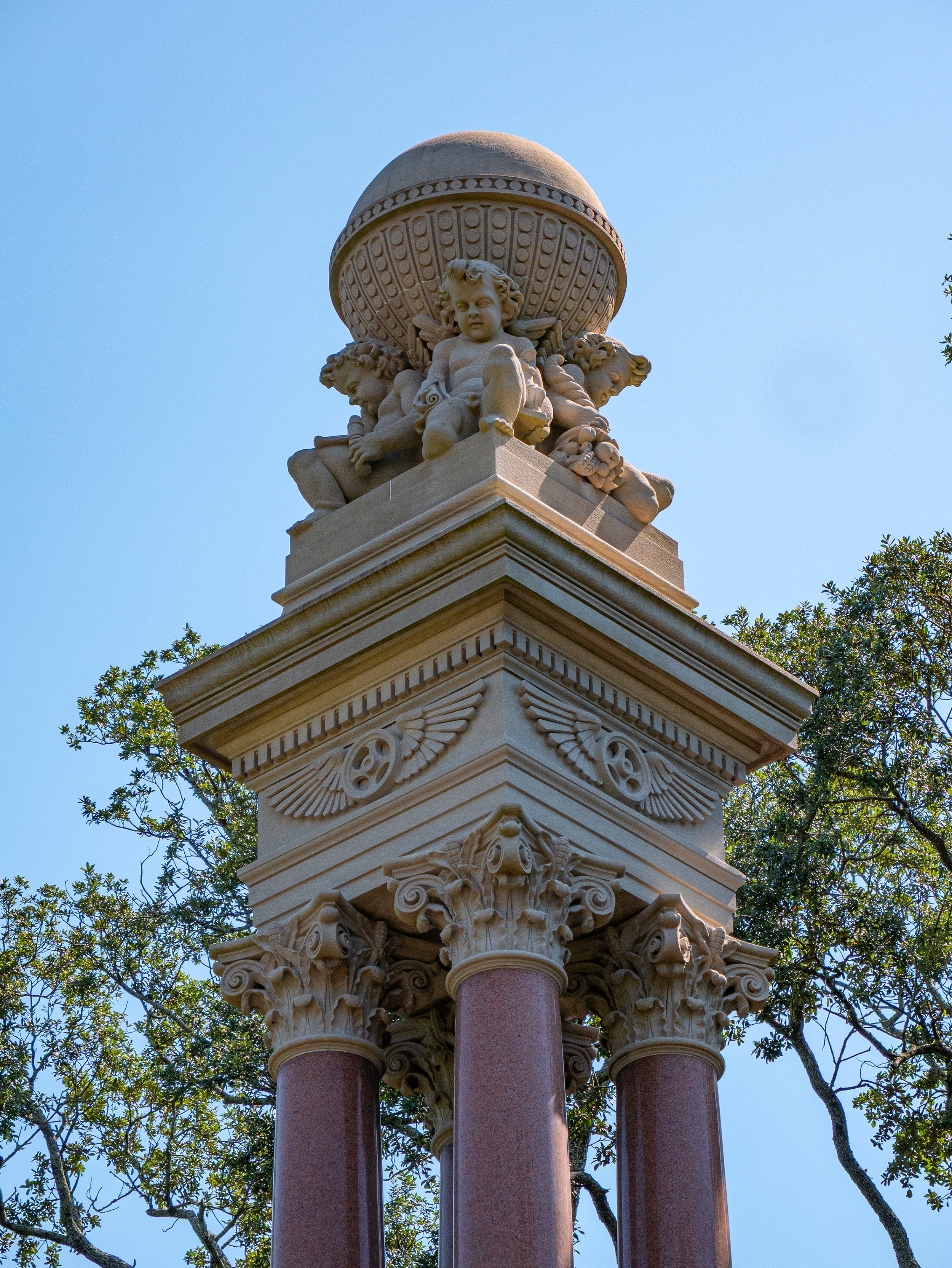
Cherubs, Corinthian capitals, winged wheels, and red granite columns enrich the Gordon Monument’s elaborate design.
Completed in 1883, the monument was designed by architects Henry Van Brunt and Frank M. Howe. Four polished red-granite columns support an elaborate upper structure adorned with sculptural figures, carved garlands, winged wheels, and a central urn.
The symbolism celebrates commerce, agriculture, manufacturing, art, and industrial progress. The winged wheel is particularly fitting for Gordon, whose railroad helped connect Savannah with the interior of Georgia and transformed the city’s economic reach.
The monument reflects the confidence of the late nineteenth century, when railroads represented speed, opportunity, and connection. Its height and ornamentation make it impossible to overlook.
Yet its location also complicates its meaning.
The monument rises above the burial ground of Tomochichi, whose own memorial history had already been disrupted. Wright Square therefore contains not one straightforward story, but overlapping narratives about whose achievements receive grandeur, whose memory is diminished, and how later generations attempt to restore what was lost.
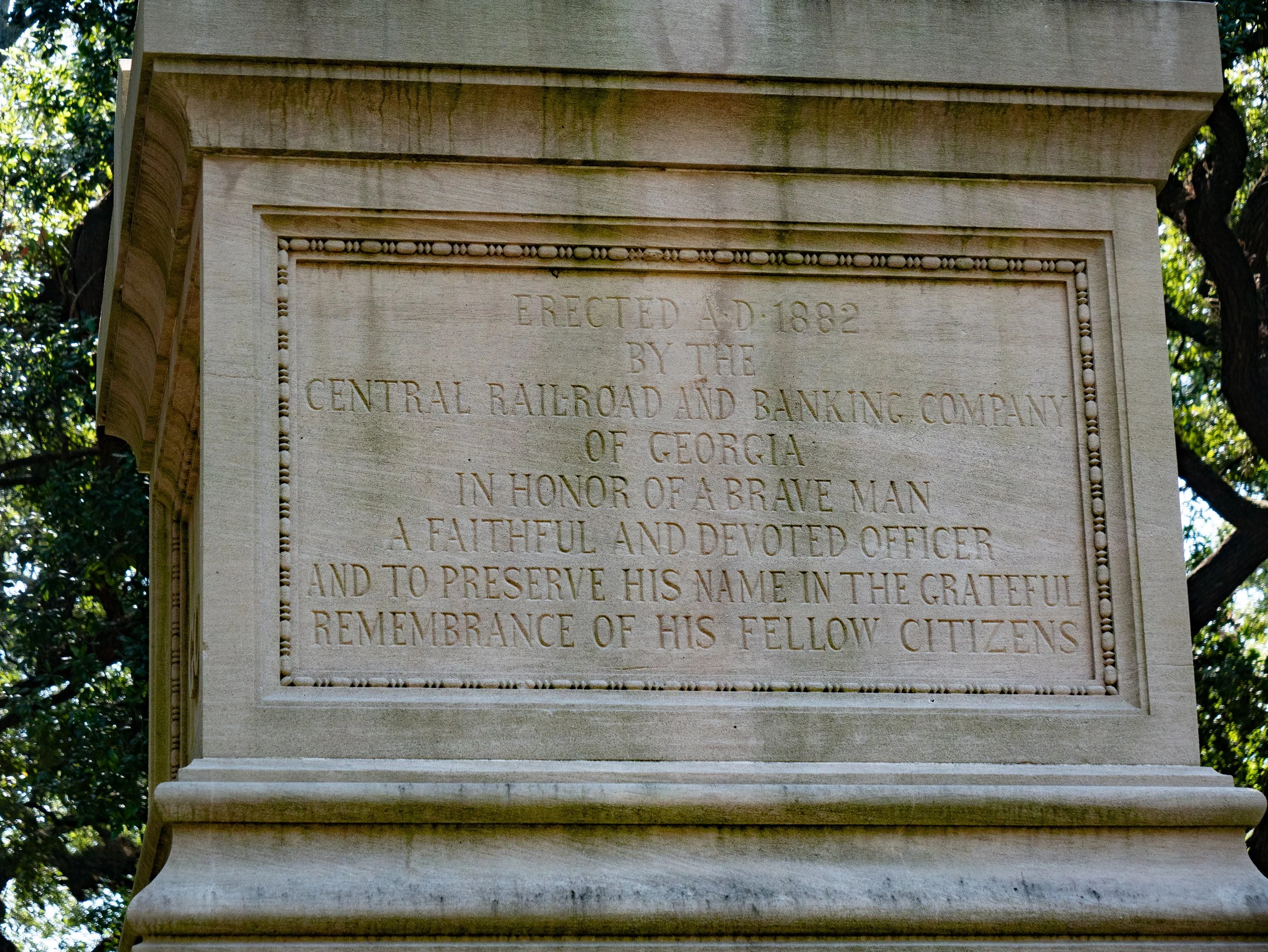
The monument was erected by the Central Railroad and Banking Company of Georgia in memory of William Washington Gordon.

Sunlight filters through the live oak canopy and strands of Spanish moss above Wright Square.
Faith, Law, and the Architecture of Authority
The buildings surrounding Wright Square deepen its historical character.
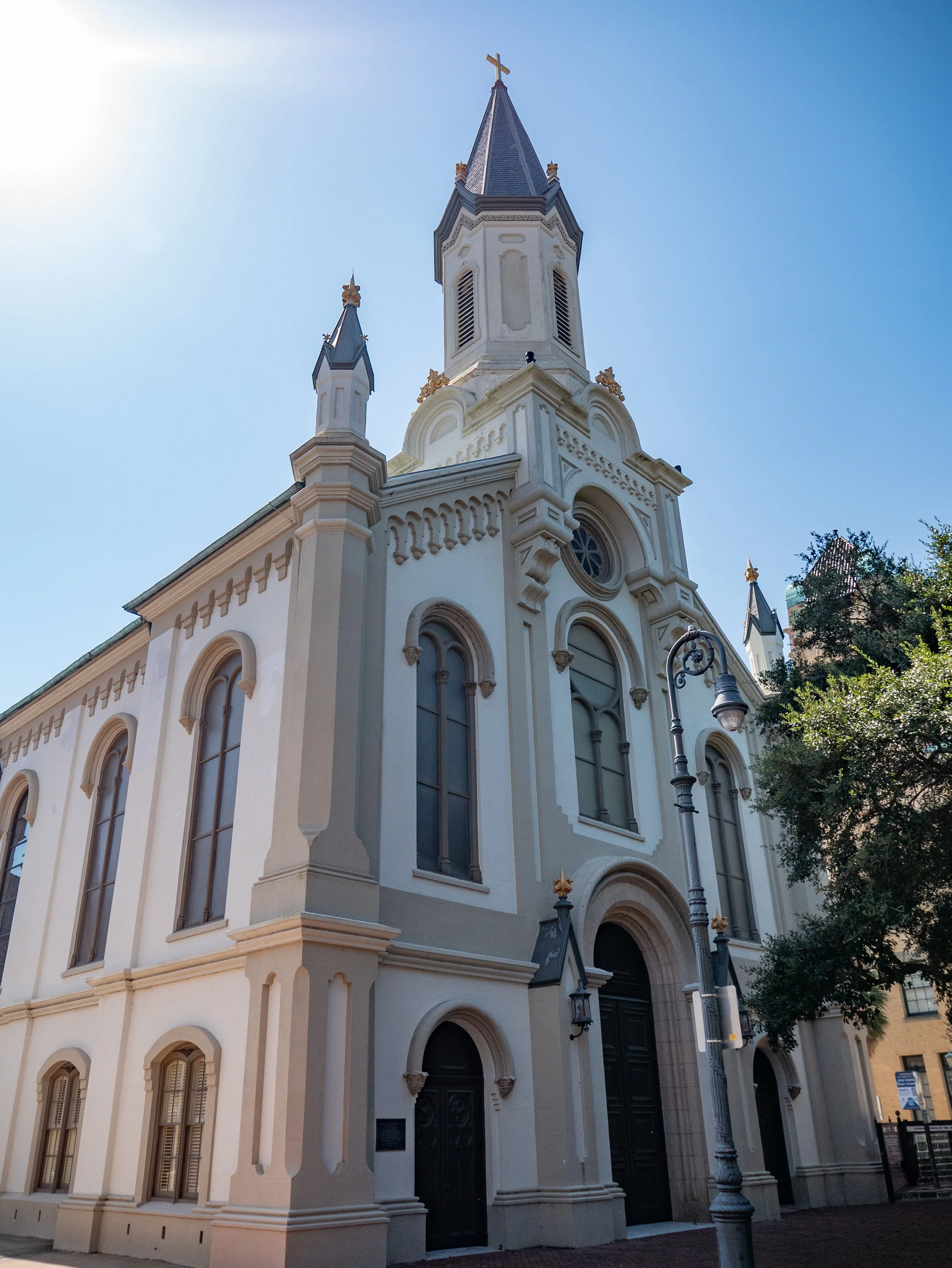
The Lutheran Church of the Ascension has stood beside Wright Square in its present form since the nineteenth century.
On the square’s northeastern side stands the Lutheran Church of the Ascension. The congregation was founded in 1741, and its members acquired the present site in 1756. The current church was erected in 1843 and extensively remodeled in 1879.
Its pale façade, arched windows, dark wooden doors, gilded details, and rising spire create one of the square’s most recognizable architectural silhouettes. In 1966, the church was designated a National Historic Landmark.
Across the square stands the former Chatham County Courthouse, an imposing brick building distinguished by its clock tower. Designed by architect William Gibbons Preston, it remains closely associated with Savannah’s civic history and continues to house county offices.
The building’s arched entrance, masonry ornament, and tower project a sense of institutional permanence. Through the trees, its clock becomes part of Wright Square’s visual rhythm, measuring the present against a setting shaped by nearly three centuries of change.
Nearby, the Tomochichi Federal Building and United States Courthouse adds another layer of civic authority. Constructed between 1894 and 1899, the Second Renaissance Revival building was designed under federal architect Jeremiah O’Rourke. Its white Georgia marble, red tile roof, and commanding tower rise beyond the oak canopy.
The building was renamed in honor of Tomochichi in 2005, extending his name beyond the memorial stone and into the civic landscape surrounding the square.
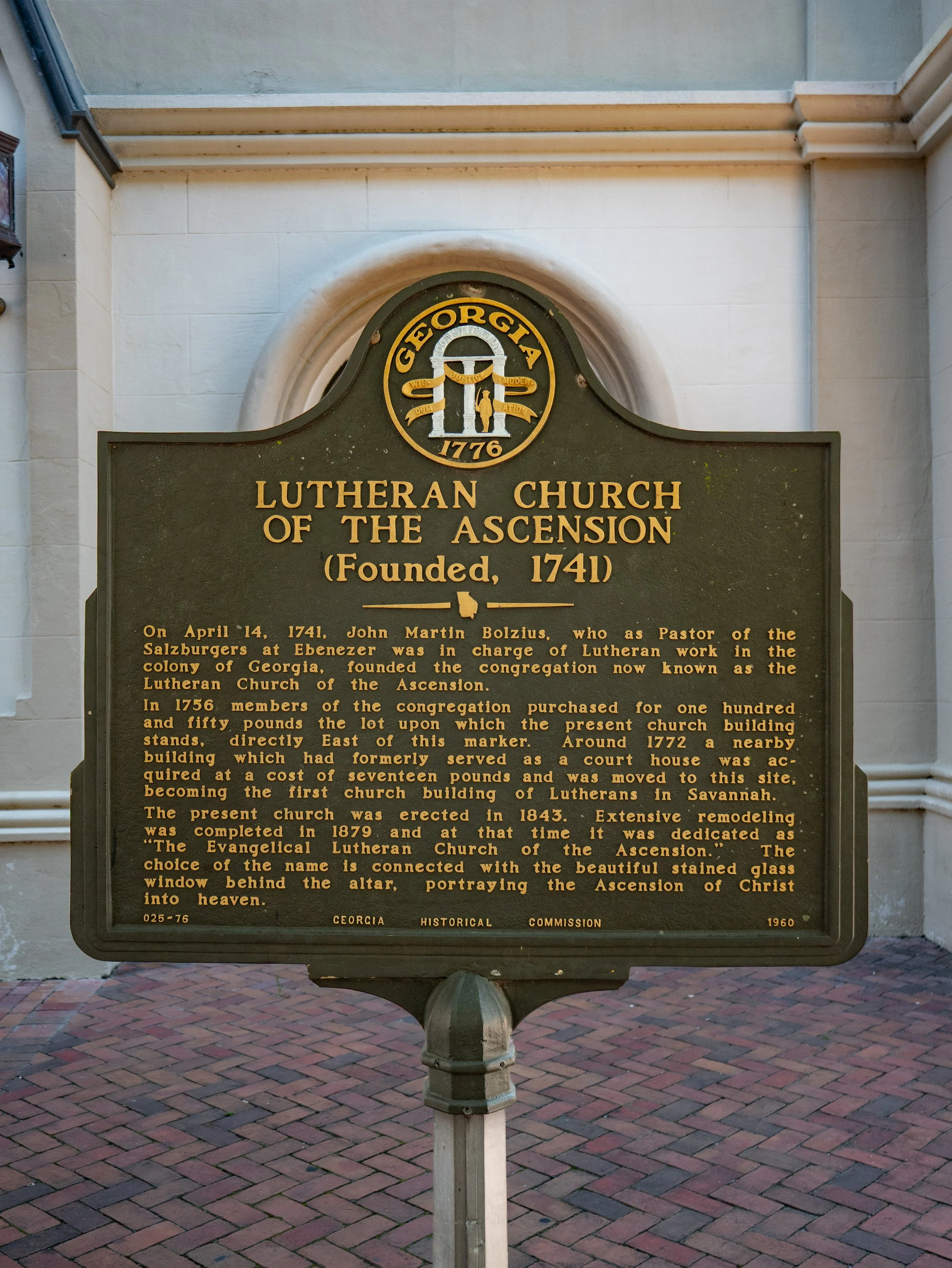
The congregation of the Lutheran Church of the Ascension was founded in 1741.
The Square Is Still Living
History is only part of Wright Square’s identity.
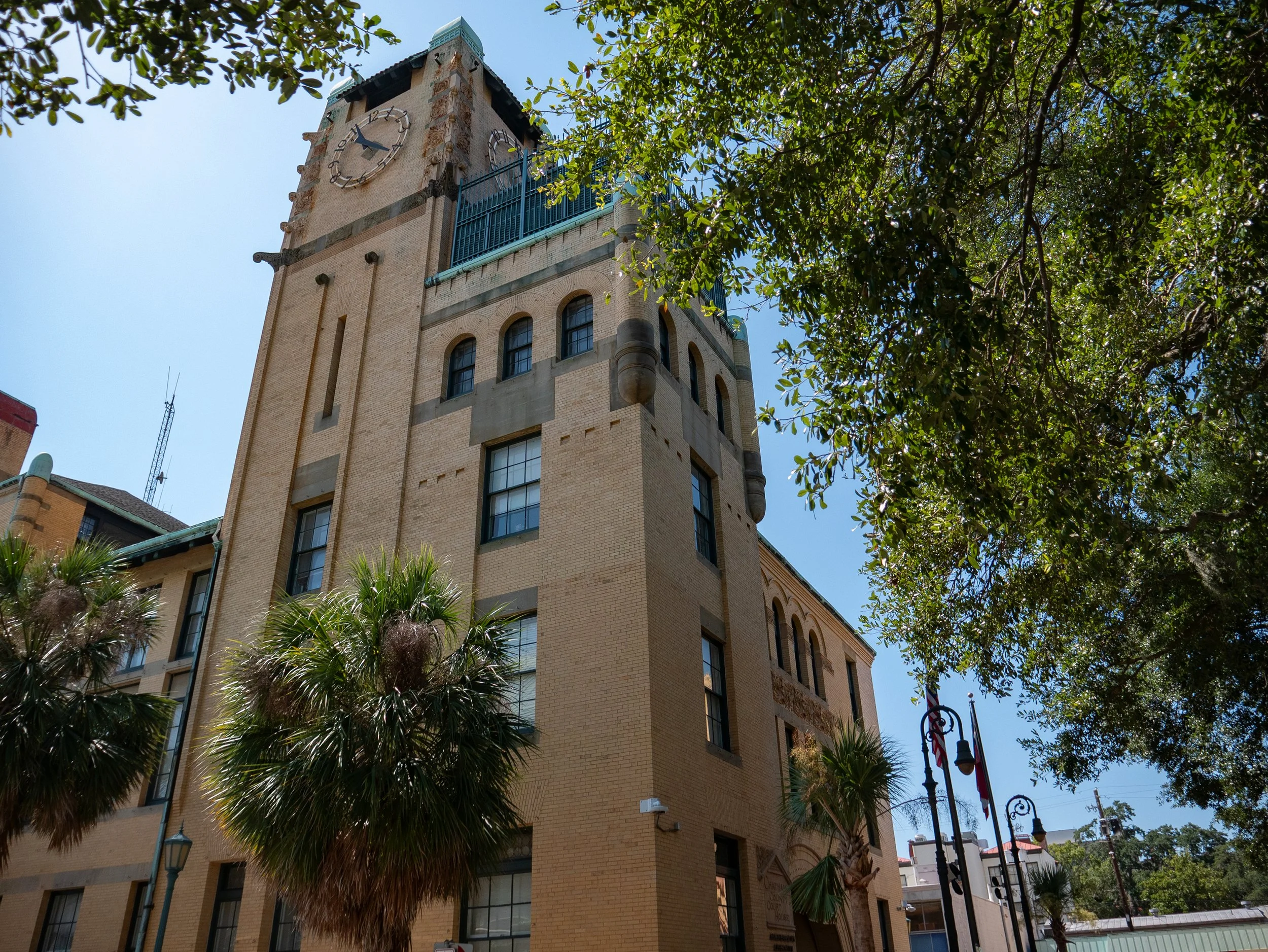
The former Chatham County Courthouse and its distinctive clock tower overlook Wright Square from Bull Street.
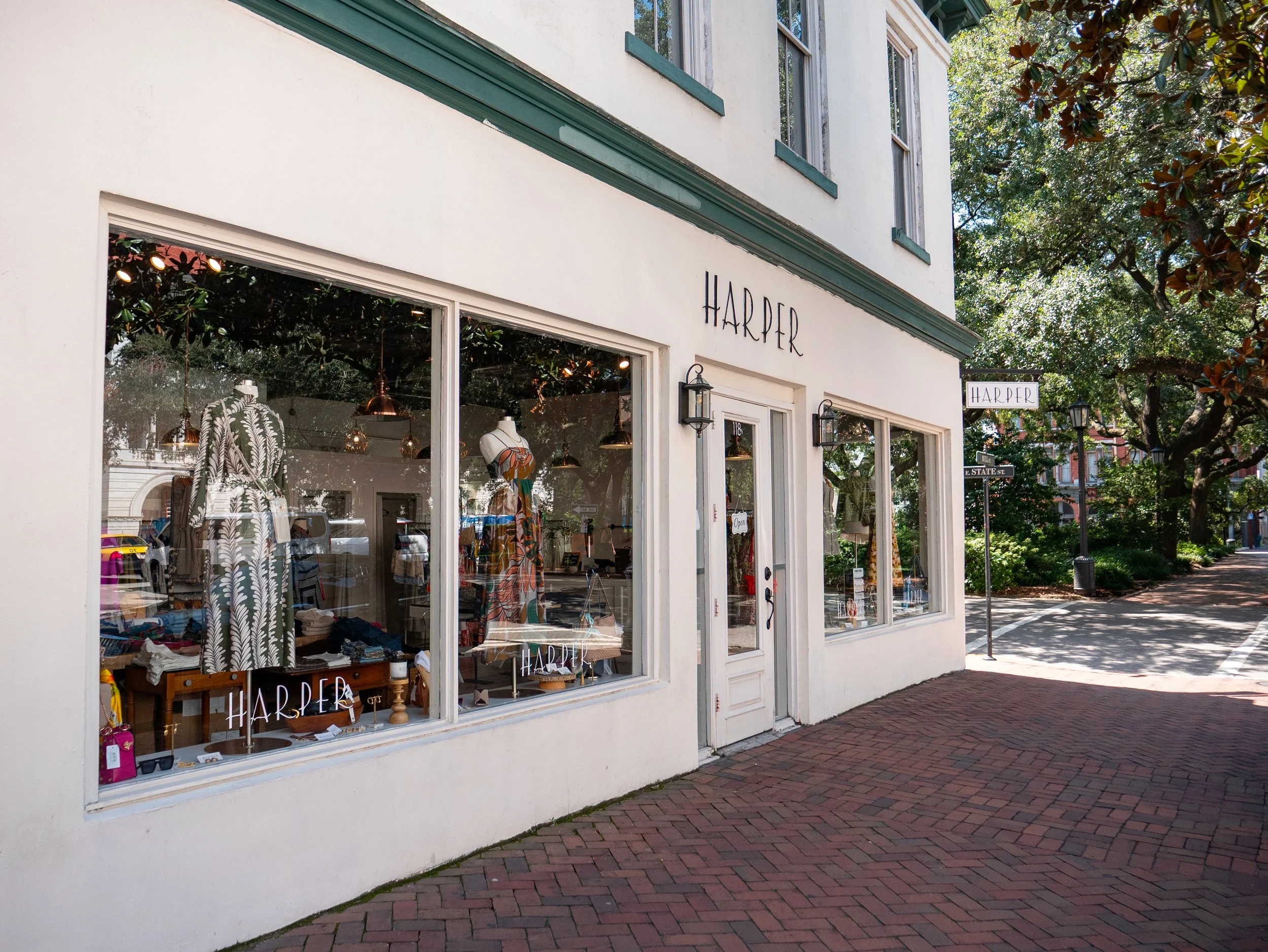
Harper brings a contemporary storefront to the historic streets surrounding Wright Square.
This is also a living downtown space where people walk beneath the oaks, rest on benches, cross between offices, browse nearby shops, and pause in the shade before continuing through Savannah.
Brick paths divide the landscaped interior. Hydrangeas, liriope, ferns, and dense green plantings soften the square’s monuments and iron fencing. Sunlight filters through the canopy, illuminating patches of brick before disappearing again beneath the leaves.
Spanish moss hangs above nearby streets and historic façades. At Bull and East State streets, traditional street signs anchor the square within the modern city grid.
Harper, a locally owned boutique at the edge of the square, brings a contemporary note to the setting. Clothing fills its windows while reflections of oak branches and historic buildings move across the glass. The storefront is a reminder that Savannah’s squares are not sealed historic exhibits. They remain part of the city’s everyday commercial and social life.
That mixture gives Wright Square much of its character. Monument and boutique, courthouse and church, burial ground and shaded bench all exist within the same compact space.
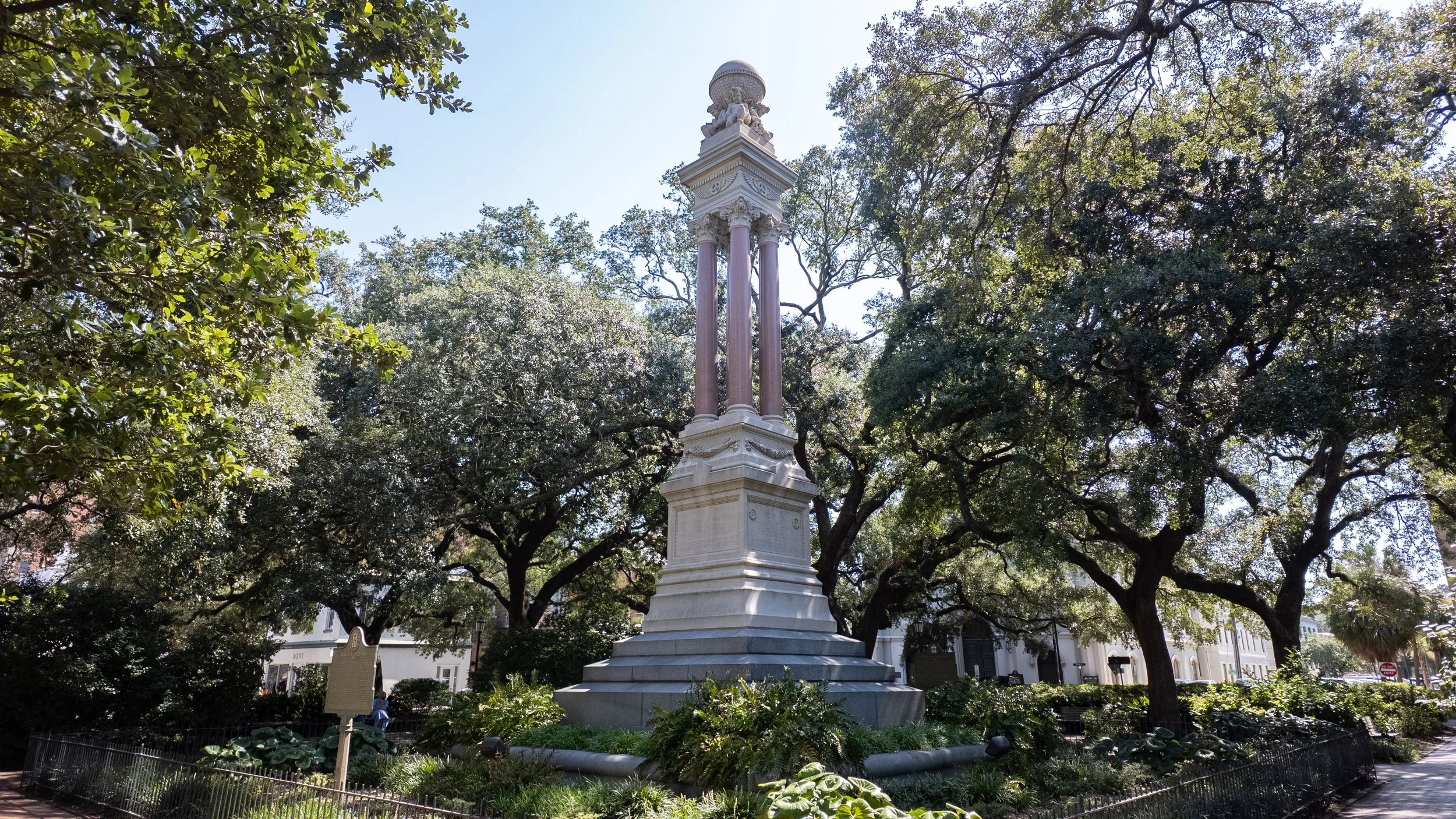
Framed by live oaks and dense landscaping, the Gordon Monument remains the visual center of Wright Square.
A Square That Rewards Attention
Wright Square does not reveal itself all at once.
Its scale encourages a slower kind of observation. From one walkway, the Gordon monument rises formally above the landscape. From another, it almost disappears behind branches and Spanish moss. The courthouse clock appears between the trees. The church spire catches the sun. A carved urn, winged wheel, bronze plaque, or weathered inscription becomes visible only after the larger scene has been taken in.
Even the landscaping contributes to the story. Flowers emerge in small pockets of light, while the live oaks create a vast canopy above the square. Sun flares through the branches and glances across stone, iron, and brick.
The beauty is immediate, but Wright Square also asks more difficult questions.
How does a city decide who receives a monument? What happens when one memorial replaces another? Can a later marker repair an earlier act of forgetting? And how should the complete story be carried forward?
Wright Square offers no simple answer. Instead, it presents public memory as it often exists: layered, incomplete, contested, and still evolving beneath the trees.
The square remains one of Savannah’s most beautiful public spaces. It is also one of its most honest, holding the city’s origins, ambitions, omissions, and attempts at remembrance within a single shaded block.
Story and photography by Charles Maring of Maring Visuals for Savannah Proper.